
Category: Longform
You are viewing all posts from this category, beginning with the most recent.
Found this little gem last night...
…while cleaning off one of our bookshelves. Completely forgot I had it.


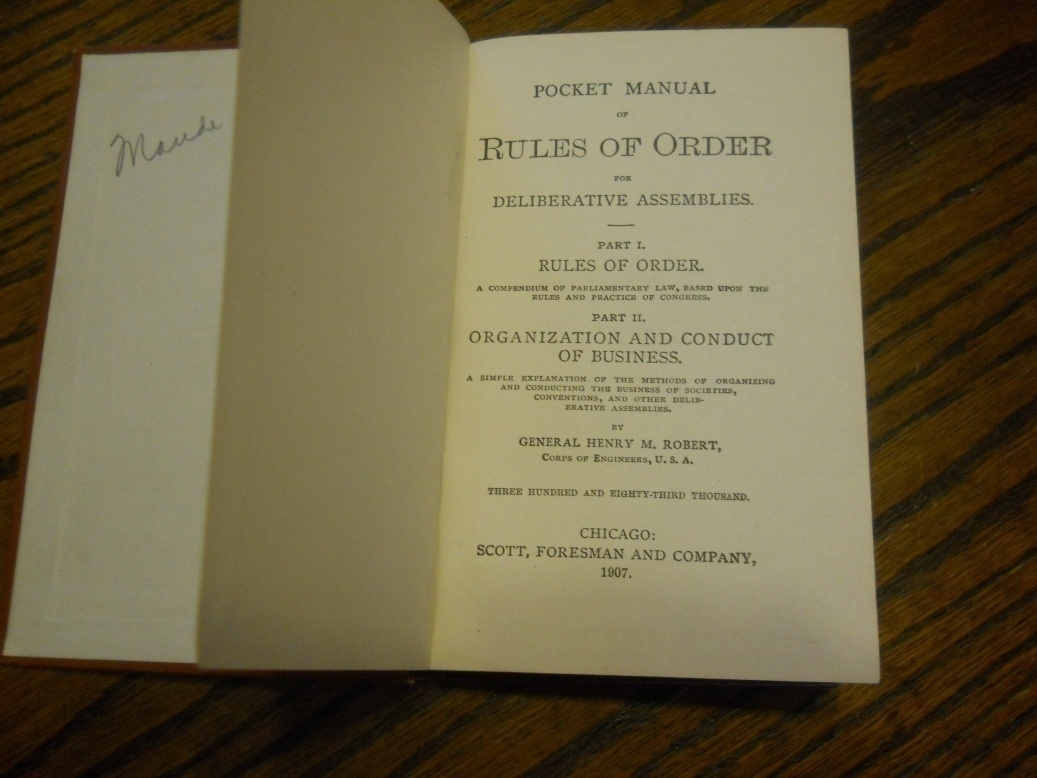
Robert’s Rules of Order, published in 1907. The signature on the inside cover is that of my great-grandmother. Pretty darn cool.
Also Bring Cold Water
Responses from right-wingers and evangelical Christians to the so-called “Ground Zero mosque” have been spread broadly throughout the cable news media and online news and opinion sites over the past few weeks. Initial responses were typical God-and-country red meat, proclaiming Ground Zero to be “hallowed ground”, and declaring that allowing Muslims to build a mosque on that site would be, (to borrow a tired phrase,) to let the terrorists win.
This response, despite the patriotic fervor with which it was proclaimed, has now finally widely been debunked (including a great bit by Frank Rich today in the New York Times). First off, the proposed building isn’t a mosque, but a cultural center. And it isn’t planned for the “Ground Zero” World Trade Center site; it’s actually two blocks away. And similar “hallowed ground” within a two-block radius of Ground Zero houses an off-track betting establishment, a strip club, multiple fast-food restaurants, and several souvenir shops (just to name a few), so it’s not like the whole area has been somehow ‘set apart’. And finally, what does it say about our belief in religious freedom if, after due process has been followed, we then want then government to prohibit the building of a religious center based strictly on the particular religion in question?
Those points may not yet have gained full acceptance, especially among Republicans looking for an election-year issue, but in general I’ve seen them make inroads in he past few weeks.
But yesterday on the Christian group blog Evangel, a post by Tom Gilson (a strategist with Campus Crusade for Christ) brings up what I believe will be the next round of argument against the project: saying that if we look at this strictly as a religious liberty issue, we are making the mistake of believing that Islam is simply another religion.
[A friend] views Islam as a religion that deserves the same rights and privileges as any other. That’s questionable, to say the least….
If you think the Ground Zero mosque comes down to a simple matter of symbolism, or of religious freedom, then you don’t understand the issues deeply enough.
Instead, the author proclaims, Islam is a way of belief whose ultimate goal is domination, and that if we don’t watch out, America will simply be Islam’s next conquest.
On this topic I have heard and seen much from both sides. I have read Ayaan Hirsi Ali’s chilling account of growing up in Somalia and her passionate assertion that Islam, as a religion, denigrates women. I have also heard first-hand from a Zimbabwean Christian pastor who warned that the Islam he encountered in Africa was intent on conquest. But by the same token I have worked for many years alongside Muslims who are gentle, family men, who had no aspirations but to provide for their families and to live here peaceably as neighbors and friends. (And, let’s face it, I can no more fairly hold all Muslims responsible for 9/11 than they can fairly hold all Christians responsible for Timothy McVeigh, Aryan separatists, and, oh, the Crusades.)
The more I think on this subject, the more I am convinced that once again right-wing Christians like Mr. Gilson have mixed up their politics with their religion and gotten it wrong. Nowhere does the Bible instruct us to protect our turf, to repel the unbelieving alien, and to presciently foil those who might intend to persecute us. But it does instruct us, often, to love our neighbors. To turn the other cheek when wronged. It reminds us over and over that our battles are spiritual battles, not physical ones. That Jesus already is Lord, and that we need not fear what mortal men can do to us.
We should stop fighting new mosques at every opportunity, and stop making enemies of dear people for whom Christ died. Instead, we should follow Christ’s command and love them.
It’s time to apply Jesus’ teaching about giving both coat and cloak. If someone comes and says ‘give us land to build a mosque’, don’t just give the land; also bring cold water (in the name of Jesus) to those who are laboring to build it.
The Perils of Hipster Christianity
Brett McCracken’s column that appeared on the Wall Street Journal website yesterday really hit home for me. McCracken, 27, outlines the increasing efforts that the evangelical church has made to try to attract and keep 20-somethings. Whether it’s the obsession with being culturally savvy, or with being technologically cutting-edge, or with using shock tactics (‘you’ve never heard your pastor talk about *this* before’), McCracken argues that they are simply gimmicks that may bring people in the door; “But”, he asks “what sort of Christianity are they being converted to?”
Quoting David Wells, he further adds:
And the further irony is that the younger generations who are less impressed by whiz-bang technology, who often see through what is slick and glitzy, and who have been on the receiving end of enough marketing to nauseate them, are as likely to walk away from these oh-so-relevant churches as to walk into them.
McCracken concludes that “cool Christianity” is not a “sustainable path forward”, and that, “when it comes to church, [twentysomethings] don’t want cool as much as we want real”.
It’s worth reading the whole post. I, for one, give him a hearty Amen.
A day with family
Today we had the chance to enjoy what is an increasingly rare occurrence: all four of my siblings and my parents were here in Hiawatha to visit, giving us the whole family in one place at one time. (Well, almost the whole family: Andrew’s wife Heather had to stay back in Washington and work. We missed her.)
I have such a great bunch of siblings. Three brothers who are godly men, working hard and making their way on both ends of the country and in the middle. (Andrew & Heather are in Washington; Ryan is in Brooklyn, NY; Aaron and Emily are in Wisconsin.) One little sister who is just a shade (OK, maybe a little more than a shade) spoiled by her big brothers but who can keep up with all of us, anytime, anywhere. Mom and Dad came down from Wisconsin for the day, too, so we had lots of fun and frivolity and food. Much Mario Kart was played, many hot dogs were consumed, and much shrieking was heard from the girls as they ran between parents, grandparents, uncles, and aunt.
Clever and cheesy wordplay seems to be a hallmark of our family gatherings. We have a predisposition for puns and a love of mangling phrases. One such highlight from the visit is worth repeating, if only as an illustration.
Andrew, talking to Ryan, mentioned something about a “love cube”. I have no idea what that meant. However, it immediately made me think of the song “Love Shack”, so I started singing a twisted version:
“The love cube is a polygon where… we can get together…”
OK, yeah, cheesy. They indulged me with a chuckle. But then Ryan, per usual, came up with a retort.
“So, if you were involved in that love cube polygon thing, would you be… a… ‘polygonist’?”
Groan.
Anyhow, it was a great blessing to have everybody under one roof, if only for a day. God is good.
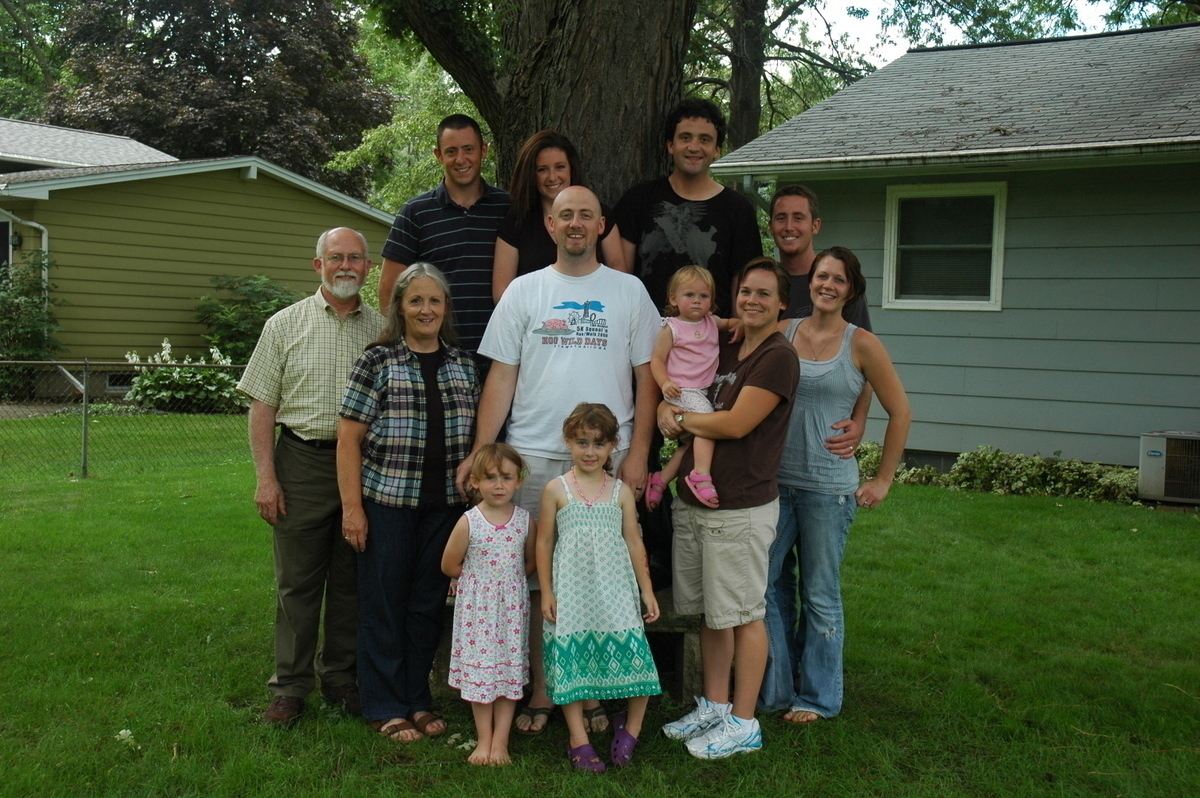
Top row, L-R: Andrew, Rebecca, Ryan Middle row, L-R: Dad, Mom, Chris, Katie (being held), Becky, Aaron, Emily Bottom row: Addison, Laura (click to see a bigger image)
12 years
June 26, 1998, on a sweltering night in Charlotte, NC, Becky and I made vows, exchanged rings, and began our life together. Twelve years, three kids and one cross-country move later I am still so thankful that I can wake up every morning next to my best friend. She is a faithful companion, loving mother to the girls, tireless gardener and homemaker, and I am blessed to have her as my wife.
I love you Becky! Here’s to the next three dozen years!
Learning to spell a new word, or, how do you spell 'blerg'?
It’s fascinating to see how a new word evolves, especially in the case where a word is introduced not via written text, but rather via audible means. Twenty-one years ago Homer Simpson’s “D’oh!” appeared on the cultural scene, and quickly became a part of the American lexicon. Its addition to the Oxford English Dictionary in 2000 officially marked its transition from a cartoon interjection to an accepted part of the ever-evolving English language.
With “D’oh!”, a standard written form of the word was quickly propagated by means of episode titles of The Simpsons. The past few years, though, have introduced a new interjection with much less apparent standardization. I’m talking, of course, about Tina Fey’s portrayal of the character Liz Lemon on the popular NBC sitcom 30 Rock, and her exclamation of disgust that Wikipedia appears to have settled on spelling “blerg”.

Anyone surfing the web in the past couple of years will have encountered any number of variant spellings, all apparently based around the various authors’ ideas of how it should be spelled. Google is of great help in honing in on the popular options.
‘Blergh’ - about 94,700 results.
Adding an ‘h’ to the end is a popular way to go - Blergh is quickly found on this budgeting website and as the name of the self-proclaimed “official boy band of the 21st century”, an Aussie group whose Facebook page, as of today, boasts 17 fans.
‘Blerg’ - about 47,500 results.
This comes as a bit of a surprise, given that this is the spelling that Wikipedia has settled on. The Liz Lemon page on Wikipedia provides some insight into usage: “Liz also has a tendency to say the words “blerg” and “nerds” as a replacement for swear words.”
‘Blurg’ - about 170,000 results
It is apparent that the English-speaking world thinks that the /ur/ spelling is more intuitive than the /er/. Additional popularity for this spelling is evidenced by blogs named with this spelling, for instance blurg.tumblr.com and blurg.wordpress.com, and the fact that my wife uses it in all of her instant message sessions. (No major blog links showed up for the first two spellings. Grab ’em while you can!)
‘Blurgh’ - about 214,000 results
What is it with the added ‘h’? This hefty spelling appears to be the most popular, and has the added weight of being the spelling used by Tina Fey when she wrote about it on the 30 Rock blog.
A hint as to the fictional origin of the word can be seen in a shot from the Pilot episode of 30 Rock where this pile of unassembled Ikea-esque furniture is shown in Liz Lemon’s apartment:

Come to think of it, I might use the name of pesky assemble-it-yourself furniture as a swear word, too, if I were coining words. Using the ë, though, makes it a little bit tough to type. As for me, I’ll stick with ‘blerg’.
Another thought on church shopping and polarization
Yesterday’s post on church shopping and cultural polarization reminded me of a question I’ve been cogitating on for the past week or two.
What would it look like if we were forced to go back to attending local community churches? How would it affect our view of what was necessary in a church and what things were “essentials”?
Say gas prices spiked to the point where we couldn’t afford to drive the 10 miles each way to our church of choice. Our choices are now walking or riding bicycles on Sunday morning. In my neighborhood, that would limit my choices to four churches, one Catholic, one United Church of Christ, one “Community of Christ” (which I know very little about) and one Lutheran Church Missouri Synod.
In our 2008 church search (not limited by driving distance) we didn’t really consider any Lutheran churches; would a walking-distance limit change my mind? Probably, given my options. Another possibility: would we canvas the neighborhood to see if there were other like-minded evangelicals who wanted to meet in a house church with us? Seems like an option, but it also seems somewhat fractured and silly given that there’s a LCMS church in the neighborhood.
See how quick the criteria changes? All of a sudden I’m thinking about what might be “good enough” rather than finding the church that’s exactly what I want. So what I’ve proved (to myself, at least) here is that in my non-distance-limited church choosing I’ve unconsciously made a tradeoff, choosing a church that more closely aligns with my doctrinal and worship style comfort zone above a local church that would have me going to worship with my neighbors.
This isn’t an unusual trade-off; it’s one that our suburban culture has widely adopted. Gas is (relatively) cheap, driving everywhere is natural, and so we spend time in the car to associate, or shop, or worship, with those of our choosing rather than those of our neighborhood. And this post isn’t really all that different from a slew of other blog posts and books wrestling with the suburban culture and longing for a true local community.
But it’s a challenging exercise to think through. What churches would you have as options? What would you do?
Church shopping and cultural polarization
CNN.com has a blog post today exploring “How Church Shopping is Polarizing the Country”. Written by law professors Naomi Cahn (George Washington University) and June Carbone (University of Missouri Kansas City) who have recently co-authored a book on cultural polarization, the particular focus on church shopping intrigued me. Heck, I was church shopping not all that long ago. I’m helping cause cultural polarization? I must know more.
Fascinating (and saddening) are their definitions of the two polarized camps: traditionalists, who “…believe in an eternal and transcendent authority that tells us what is good, what is true, how we should live, and who we are”, and modernists, who “…would redefine historic faiths according to the prevailing assumptions of contemporary life”. Modernists, they note, “…have become less likely to attend church at all.”
In previous generations, they say, both modernists and traditionalists tended to attend the same churches, typically right in their community. Today, though, the ability to church-shop has the traditionalists seeking out churches that affirm their “personal values”, and has modernists staying home.
The authors lament the decline of the mainline Protestant denominations that in previous generations housed both camps, and complain that today’s evangelical churches (full of like-minded traditionalists) are self-reinforcing in belief, and that evangelicalism’s close ties to the Republican Party serve to marginalize those who might be in agreement politically but not religiously (or vice versa). In the end, they say, traditionalists group together and talk only to themselves, and modernists leave church altogether, resulting in an increasingly polarized society.
There are certainly places where I disagree with the authors’ views on the topic. I think that Protestants seeking churches where their beliefs are shared and reinforced is a good thing. And drawing rosy pictures of a post-WWII generation where everyone attended the same community church regardless of what they believed only serves to hide the fact that those weak, any-belief-is-OK churches in large part helped cause the modernist/traditionalist divide we see today, by valuing the form-over-substance mindset that was eventually cynically discarded by Generation X.
However, within the microcosm that is the evangelical church, there are good lessons to be learned here. We need to be vigilant to ensure that we limit our “distinctives” to the fundamental Gospel truths. As soon as our teaching, or even our church culture, becomes, even by way of unspoken assumptions, ’the gospel plus conservative politics’ or ’the gospel plus homeschooling’ or ’the gospel plus pre-millennial dispensationalism’, etc., we will alienate those who either desperately need to hear the Gospel or who could be vibrant, participating members of our local body.
The good news that Jesus Christ is Lord of all is polarizing. We should not be surprised when law professors find it so. But there is still a lesson for us here: let the Gospel be polarizing, not the cultural things we are so apt to add on to it.
So, I just invented a new word.
Fidgetoid, n. an object with which one fidgets.
A Google search reveals no substantive results, so I’m gonna call this a new one.
It came up after this Tweet from Geof:
I’m a fidgeter at a desk. I fidget. My current object of fidgeting is a UAH Hockey puck that Coach Cole gave me. Indestructible.
My reply:
@gfmorris A hockey puck is a good fidgetoid. Can cause some damage if you get mad and throw it, though. :-)
There you have it: language evolution in progress. I can only hope that my language hero, the late William Safire, would be proud.
Well, we joined.
After taking quite a bit of time to make our decision, Becky and I yesterday became members of Stonebridge Church (EFCA). For a while we were wondering if enough members would show up to form a quorum so we (and 14 others) could be voted into membership, but eventually enough trickled in to make it official.
It feels good to have made the decision and committed to a body of believers. We are very thankful that God has led us to this fine group of folks as we continue through life’s journey.