
Category: Longform
You are viewing all posts from this category, beginning with the most recent.
Hard, true words from @tallskinnykiwi
Andrew Jones (aka “Tall Skinny Kiwi”), “itinerant social entrepreneur”, wandering missionary and prolific blogger, has a hard but true, and dare I say, prophetic post on his blog today. It’s unfortunate that the piece is headlined as an appeal to be chosen to speak on The Nines, because the bulk of the post is about the changes coming for the church and for Christian culture.
Did I mention it was a hard word? Here are just a few of his headline points:
- Church as we have known it is not the first option for the next generation. Neither is it an affordable option. It is not sustainable in the long term.
- Seminaries are in trouble.
- The Christian music industry as we have supported it, is over.
- The Christian publishing industry, as we have enjoyed it over our lifetime, is over.
- The church planting movement, in its ecclesiocentic and unholistic form, has played out its song and is now doing an unrequested encore.
- Prayer meetings are focused on making our outdated methods work better.
“If Americans want to play in the sandbox in global missions and sustainable holistic church ministry”, says Jones, “then they need to listen to what the majority world is already discovering and implementing.” He says that we can and should use this time of recession to re-orient and re-calibrate our thoughts on ministry and mission rather than just asking for more money.
You should go read the piece to hear his whole argument. Hard as it may be, I think Jones is right.
So I'm gonna do this...
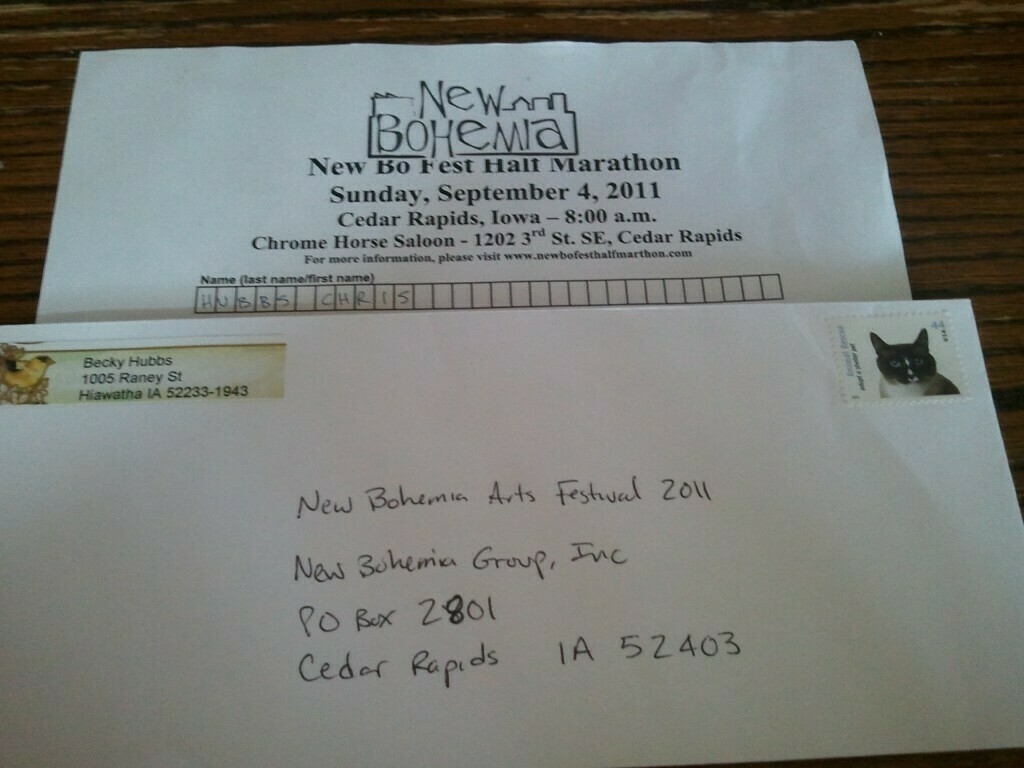
Finally biting the bullet and sending in this registration. 7 more weeks to prepare!

Learning to run
Running isn’t exactly a new topic on this blog. I first decided to lace up my shoes back in August of 2006 and ran my first 5k in September of that year. After the initial 5k I never trained much for the races. I’ve run the local Hog Wild Days 5k every year since then, but even then never trained much or cranked up the pace much. My race times evidenced that fact: I ran that first 5k in 31 minutes and change, and 4 years later I was still running right about 30 minutes for a 5k.
At some point this spring, though, some switch flipped in my head, and running became enjoyable and something of a compulsion. I started tracking my runs using runkeeper.com and being more regular with my running. I got in more than 50 miles in April, 47 in May, slacked in June whilst on vacation, and now I’m back at it in July.
My times are showing the improvement. I felt pretty darn sluggish for the Hog Wild Days 5k this year and still completed it in 27 minutes. Then I ran the Alliant Energy 8k on July 4th and completed that in right at 45 minutes.
At the moment I haven’t made a real decision on whether to work for distance or speed next, but I’m leaning towards distance. I ran a 6-mile route this morning and really enjoyed it. I’ve been tossing around the idea of running the New Bo Half Marathon over Labor Day weekend, but haven’t been brave enough to send in the registration form yet. Either way, it’s time for a new pair of shoes between now and then.
I’m still working on understanding why I enjoy running as much as I do. Partly it’s the personal challenge, proving to myself that I can stretch my body beyond where it’s gone before. Partly it’s also so nice to have my body feeling perpetually tired and sore rather than slow and sluggish. It’s also nice when the running helps take off a few pounds.
I doubt I’ll keep with the running long-term as seriously as I have this year, but it’s something I want to keep as a regular part of my life. 30 years from now I’d love to be one of those old guys I saw in the race on Monday, still chugging along and running 5 miles faster than a lot of the young guys.
More about church efficiency and effectiveness
I’ve been mulling over Skye Jethani’s question about efficiency and effectiveness after my brother Andrew prodded me with some comments. Andrew argues for prioritizing efficiency and effectiveness thusly:
If reaching people with the Gospel is the ultimate goal, then efficiency (the stewardship of resources towards the greatest gospel advance possible) and effectiveness (the fruit of that stewardship) is essential. We’re asking, ‘what do we have that is being used for missions, and how well is it doing its job?’ If you’re not constantly asking those two questions than you’re not really going to be ‘effective’..
I’m beginning to think that we actually more or less agree on the need for efficiency and effectiveness, but are looking at it in different perspectives. Because the goal is two-fold: “preach the Gospel”, and “make disciples”.
Now, maybe we can preach the Gospel most effectively by just taping the “best of” sermon series from and distributing it via video to every corner of creation. But does that help us with disciple-making?
Or does it possibly stunt our disciple-making efforts because it takes away opportunities for men to become teachers and hone their teaching skills, and for local pastors to tailor teaching to speak specifically to the needs of their local congregation?
We’re getting a ways off here from Jethani’s original point, maybe. And yeah, I’m sure any well-run megachurch is going to need an amazing elder board to hold it together. But I think we would do well to learn from the example long set before us: of small, local churches with local leadership, benefiting occasionally from the all-star teacher who was visiting town. Maybe efficiency and effectiveness comes through grassroots insurgency rather than from video sermon distribution.
Having written all that… if you need me, I’ll be off catching up on Matt Chandler’s podcast.
Who decided that efficiency and effectiveness were the highest values for ministry?
There’s an excellent post from Skye Jethani today which hits close to home for me in a number of ways. First off, he’s taking a lesson from the redundancy that is built in to airplanes, making them the safest way to travel. (I’m a certification engineer at an avionics company, so I am very familiar with what he’s talking about.) Second, he asks what the church should be learning on this issue. It is wise to structure a large church organization around a “main man”?
(This also hits home because there was a time in my history when I was told that I would cause great damage to my particular church if I chose to follow what I felt was God’s leading to go elsewhere. I wasn’t the pastor - only an elder and part-time worship leader. I went ahead and left anyway. The church, of course, was fine. But that’s a different story.)
Jethani is asking questions about places like Bethlehem Baptist (John Piper) and Redeemer NYC (Tim Keller), both of which are large organizations built around single, superstar pastors. (Other churches quickly come to mind - Mars Hill Seattle (Mark Driscoll), for instance.)
…whenever I’ve discussed this inherent danger [of a single failure affecting multiple congregations] with those operating video-based multi-site systems they invariably mention the efficiency and effectiveness of their model. Who can disagree? Utilizing one highly gifted person to impact thousands of people in multiple cities is unquestionably efficient….
But who decided that efficiency and effectiveness were the highest values for ministry?
Boom. Awesome question. Jethani goes on to enumerate some reasons why a more redundant, less efficient organization might well be healthier for churches. It’s worth a read.
And oh, yeah - about those airplanes? Some of the most amazing safety engineering ever done happens on those aircraft. They include redundancy in ways you’d never imagine. Very cool stuff.
Seeing the people instead of the system
I’m still catching up a bit, but I definitely want to recommend this piece by Richard Beck wherein he examines how bureaucratic structures in the world tend to dehumanize us.
In each of the [stories above] human beings are not interacting directly. We are, rather, interacting through the power structures of the world. I don’t know the name of the man in my backyard about to turn off my electricity. And he doesn’t know my name. Our relationship is, rather, defined by our locations in a bureaucratic power structure. He’s an agent of the electric company. I’m an address on his work order. That is how our relationship is defined. A relationship stripped of its humanity. And as a consequence I have to work mightily to treat this man with respect. He isn’t to blame. But everything about this dehumanized interaction makes me want to yell at him. To direct my anger at him.
We’ve all been there, haven’t we? How easy it is to rage against people who are only trying to do their job. Beck calls us to vigilance:
On and on it goes. If we are not careful, if we are not vigilant, if we are not prayerful modern life will dehumanize us. It is a demonic force that must be resisted. I keep going back to something William Stringfellow said, we must struggle to live humanely in the midst of the Fall.
And he closes with a fantastic illustration that I won’t copy here, but that is worth reading in full; go take a look.
A Rant about a Church Sign
There is a Baptist church in our town that I drive by on my way to church at least a couple of times a week. For the past couple of weeks they’ve had a message up on their sign that has irritated me to no end. Now, sayings on church signs have a way of being trite and cutesy, but this one has surpassed that and gone on to outright misguided ridiculousness.
First, the quote from the sign:
“Don’t make me come down there!” – God
Here begins the rant.
I’m trying to think of ways this could be interpreted, and no matter how you do it, they’re all bad. Some things it could be construed to be saying:
- God isn’t actually involved down here on earth right now. Apparently He’s somewhere distant, and just observing. That’s obviously incorrect.
- People on earth are at some marginally-acceptable level of sinfulness right now. Wrong again! We’re all sinful. No one does good. We’ve all missed the mark.
- If we cross some line of sinfulness, then… BLAM! God’s gonna come down and make us pay! No. God isn’t up there threatening to blow us away. He promised he wouldn’t flood the earth again and wipe everything out. (I have to remind myself of that when the springtimes get abnormally rainy…) And He poured out His wrath on Jesus. Jesus died so we don’t have to.
- God coming down here to Earth is a thing to be feared. Uh, no. God coming to Earth in the person of Jesus is the best thing that’s ever happened to Earth and humankind.
I assume somebody at that church saw the message on the internet somewhere, thought it was clever, and put it up without even thinking any further about it. It pains me that the message has been there for weeks now and apparently no one at the church has discernment enough to recognize the gross error and get it taken down.
A message to church sign designers everywhere: if you’re going to put a weekly message on your sign, keep it informational, or, at worst, cutesy. This sign is a big steaming pile of pseudo-cleverness served with a nice heretical gravy on top. Make it go away.
Moving at the speed of love
Richard Beck has a great piece today on interruptibility.
Basically, interruptibility is a form of welcome and hospitality. It is a way of making room for others. This space we create is less a physical space than a temporal space, making room in your To Do list, making space so we can slow down and pay attention to others.
Interruptibility is, he says, “a sign that we are moving at the speed of love.” (What a great line!)
Beck goes on to explore some other traits that our interruptibility (or lack thereof) demonstrates. It’s worth reading the whole thing.
My 5K Playlist for Hog Wild Days
It’s been a while since I’ve reworked my 5K playlist. This latest incarnation may be a little heavy on Arcade Fire, but I’ve been listening to them a lot while I’ve been running this spring, and the tempos of the songs work really well. Anyway, here’s what I’ve got:
- “Modern Man” - Arcade Fire
- “Beautiful Day” - U2
- “Brighter Day” - Gungor
- “City With No Children” - Arcade Fire
- Someone Else’s Arms - Mae
- “After The Garden” - Andrew Osenga
- “Month of May” - Arcade Fire
- “Hometown Glory” - Adele
If I finish in the time I’m hoping for, I’ll be somewhere in the middle of “Month of May” when I cross the finish line. The Adele song is a fantastic cooldown song.
Here’s hoping for good weather in the morning and a good race time!