
Category: Longform
You are viewing all posts from this category, beginning with the most recent.
"When I Was A Child I Read Books" by Marilynne Robinson
I’ve gotten to the point where, unless I’m looking for a specific book, I don’t even visit the main stacks of the library any more. Instead, I head right for the “new books” section, and pick up a recent novel or biography.
While perusing the new book shelf during my last visit, I picked up Marilynne Robinson’s book of essays on a whim. It’s not the type of book I usually pick up, but it looked interesting enough, and short enough that I had a chance to get through it without getting majorly bogged down.
Marilynne Robinson teaches at the Iowa Writers’ Workshop at the U of I. She’s probably best known for her novel Gilead, which won the Pulitzer Prize for Literature in 2005. It ends up, though, that she’s published more essays than she has novels, and, if her latest volume is any indication, her essays are really good.
When I Was A Child I Read Books is a short, dense collection of essays that perhaps have less to do with reading books, and more to do with the intersection of faith and the current American religious culture. Robinson stakes out a middle ground that on one hand rejects the liberal theology of mainstream Christian denominations, while simultaneously opposing the apparent hard, uncaring line heard too often from the far right wing.
I have felt for a long time that our idea of what a human being is has grown oppressively small and dull.
Robinson’s essays call us to accept and embrace the mystery and beauty of being human. She urges us to give others the benefit of the doubt, to live with compassion towards even (especially?) those who we don’t know or understand.
There is at present a dearth of humane imagination for the integrity and mystery of other lives.
When I Was A Child I Read Books was slow going, but only because there was such richness to savor on every page. If you have the time for some thoughtful reading, I’d recommend this book.
The sure sign that I'm not blogging enough...
…is that I start blogging about blogging, and I start thinking more about how I’m going to modify my blog layout/structure/etc than what I’m going to write about next.
That being said, I’ve been tempted lately to mess around with Jekyll, spin a simple layout/theme of my own, and convert this site to a static site driven by text file inputs.
But if I’m honest with myself, I know that my blog doesn’t get so much traffic that making it static actually matters performance-wise, and I might not even like the blogging process as much when I change it up. I’m really just interested in the setup and conversion process.
I think I need to find something more productive to work on.
Some Android / iPhone follow-up
So the same day I published my previous post on ditching my Android, a customer service guy from US Cellular named Tom pinged me on Twitter and asked for my email address so he could respond. I sent it to him, and he responded with a 1000-word treatise trying to address some of my points.
Highlights from his side of the story:
Android OS Updates Samsung actually stopped releasing software updates for all 1st generation Samsung Galaxy S devices. Samsung made the decision that this line of devices would not get an official Ice Cream Sandwich 4.0x or Jelly Bean 4.1x update. … This is much like Apple no longer supporting older hardware be it OSX Lion on an older Macbook or IOS 6 on an older iphone. As the software requirements are greater, older technology is rendered obsolete.
OK, so it’s not US Cellular’s fault, or Google’s fault - it’s Samsung’s fault. Still, his comparison to Apple/iPhone is misguided. As I pointed out in my original post, if I’d bought even the older iPhone (3GS) available back in December 2010, it would still be able to pick up the IOS 6 upgrade later this year. Advantage: iPhone.
Backup
Backing up an Android device is a different story. If you are looking for ways to back up specific application data, then there isn’t much I have found out there to do this…
To be fair, he notes that you can use Google to keep your calendar, contacts, and mail in sync w/ your Google account. But still, otherwise, he concedes the point. Android’s backup solutions all suck, and to do a full apps/settings backup requires you to root your phone and void the warranty.
System Stability This is something that has only been getting better with newer hardware and software. My Galaxy S II for example has never had any issues with freezing up. My wife has the Mesmerize and from time to time will have issues with certain applications causing her phone to freeze. The Galaxy S III is in a ballpark all of its own. The hardware and software is much more advanced then even the Galaxy S II…
At this point it feels like he’s starting to quote from the promotional literature. In short: yeah, your current phone (which we sold you as top-of-the-line 20 months ago) sucks, but trust us, it’s getting better. Oh wow, I feel so much better with that reassurance! Or not.
Phone/Signal/Software issues you’ve had. It’s clear you have had issues with your phone. I do not doubt that at all. How much of this has been caused by rooting and putting different roms on the phone is unknown and can be debatable.
Ha, I knew it’d come back to this. When it comes down to brass tacks, I’ll get blamed for rooting it. But I digress.
I’ve seen the back button issue before. This can be caused by many things, from internal cracks in the digitizer, software related issues, internal hardware malfunctions, or even a screen protector not being put on the phone correctly. Your statement about it only happening in low-signal situations is the first I’ve heard this and will definitely be looking at that more closely.
Oh, great. He’ll look at it more closely. That helps me a lot.
I emailed him back with a short rebuttal, thanking him for his time. Yeah, US Cellular has been great customer service-wise. But I only use Customer Service maybe once a year. I use my phone every day. If I have to pick between one or the other, I’ll go with the phone.
I sent one last email to Tom at the end of last week, with my final summary, and an offer:
I appreciate your desire to keep me as a customer, but at this point I don’t have the time/inclination to continue a debate on the merits of Android/iPhone. I’m sure that Samsung has improved things significantly now with the Galaxy S3; however, I’m not willing right now to spend $300, mess around with a rebate, and commit to another 2 years of service to take a chance on the new Android after my previous experience, especially when I know my alternative (once my contract runs out in December) is to purchase a phone that has uniformly brilliant reviews from friends and family members.
If US Cellular wanted to provide me with an S3 at a much-reduced price, and without requiring me to re-up my contract, I’d be happy to give it a fair evaluation, a review on my blog, and return it if I still decide that I want an iPhone. (I’m not expecting that from USCC, but that’s about what it’d take at this point to get me to consider the S3.)
To this point, I haven’t heard back from Tom. I don’t really expect them to take me up on my offer.
The new iPhone can’t come soon enough.
Why I'm ditching my Android and getting an iPhone
19 months ago I purchased my first smartphone - well, two of them, one for me and one for my wife. At the time, I already owned two iPod Touches and liked them a lot. However, the service package cost on a carrier that had an iPhone (Verizon or AT&T at the time) was significantly higher than what I could get on US Cellular. So, with boundless optimism in my heart, I marched into the US Cellular store and bought a Samsung Mesmerize (aka Samsung Galaxy S). I paid $199 for each phone, along with a 2-year contract.
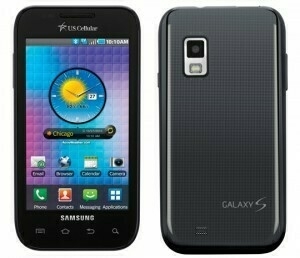
19 months later I am counting down the days until my contract is up and I can switch to an iPhone. I was amused the other day when US Cellular’s twitter folks pinged me on the topic. It’s clear at least that the US Cellular party line is “the new Android phones are awesome, forget about that iPhone thing”. And gotta love their optimism: “don’t let your experience with the Mesmerize scare you off”. Really? Why not? I spent a bunch of money 19 months ago to buy your top-of-the-line phone, and it’s turned out to be craptastic at best. Why should I not be scared off?
So, in the spirit of a Shawn Blanc or John Siracusa review, here are the reasons I’m dropping my Android phone like a hot potato and moving to the iPhone.
Hardware
Let’s start from the ground floor and work our way up. I’ve actually had less frustrations with the hardware than with the other parts of the device. The build quality is decent, even with a plastic back the phone feels like it’s high quality (though not up to Apple standards). The camera is middling at best, but sufficient.
My main beef with the hardware, though, is a nasty design flaw that causes the Back button to trigger in low-signal situations. So when I’m in a building where the cell signal is low, all of a sudden my phone goes crazy. I can’t keep an app open for long, because some sort of internal interference is triggering the back key. It’s apparently a known problem with the Galaxy S, but completely unacceptable as far as I’m concerned. The phone needs to just work, and in low signal conditions, it doesn’t.
Operating System
I don’t have too many beefs with the Android OS by itself - in fact, if I got a new device with ICS or Jelly Bean on it, I’d probably like it a lot. But because the OS is customized for each device and for each carrier, it takes forever to get a new version of the OS for my phone once it’s released, and then US Cellular started dropping support.
When I bought the phone in December 2010 it was running Android OS 2.2 (aka Froyo). 2.3 (Gingerbread) came out in December 2010 but wasn’t available for my phone until April 2011. Come on, folks, Honeycomb (3.0) was already out by then. And that’s the last update that US Cellular is supporting on the Galaxy S. No Honeycomb. No Ice Cream Sandwich. Certainly no Jelly Bean. So my operating system has been at least one version behind Android’s releases the entire time I’ve owned it, and is now three versions behind.
(Android’s full version history on Wikipedia.)
By comparison, if I’d bought the current iPhone at the time (the iPhone 4, or, heck, even the lower-tier iPhone 3GS), I would’ve had immediate download/upgrade of each new iOS release when it happened, including the upcoming iOS 6. Given that the big stability and feature advances come in the operating systems, always being behind is just unacceptable.
Now yeah, there are custom ROMs. I tried a bunch of them. Their stability was always tenuous at best, and complete crap at worst. In the end, I went back to using the stock US Cellular-provided ROM, though I did then root it. More about that later.
Ecosystem
I have two main gripes with the Android ecosystem - media management and backup. I’ll address both.
Media Management is an issue because it’s a pain in the rear to get music and photos on and off the phone. Sure, there are a few programs designed to help automate that, but they’re mostly a pain in the rear and don’t work well. Now, iTunes is still a flaming pile of poo when it comes to managing content on devices, but it’s still a far cry better than anything that works decently with Android.
And don’t even get me started about backups. The only way to fully backup the Android phone, apps, settings, texts, etc, is to root the phone and then buy a third-party backup program. And rooting the phone automatically voids your warranty. Let me say that again so it’s clear. The only way to fully backup your phone is to first void the warranty. Does that seem insane to anyone else but me?
US Cellular actually realized how much of a nightmare this situation is, or at least would be for them if angry customers suddenly realized their phones had crashed and they’d lost all of their contacts. So, they wrote some craptastic software “My Contacts Backup” that gets bundled with your phone and will backup your contacts to some unknown server somewhere. If you run it. Manually.

Applications
Application support for the Android has actually improved as time has gone on - more and more of the apps I liked on the iPhone have migrated over to Android, albeit in editions that were typically uglier, missing features, and running more unreliably than their iOS counterparts. I’m getting to the point now, though, where new apps that come out won’t run on the phone because I need a newer version of the OS. After only 19 months, my device is going obsolete. Grrrr.

System Stability
I don’t know whether to blame this one on the hardware, the OS, the applications, or some combination of all three, but for most of the time I’ve had it, my phone has locked up to where I had to do the three-button reboot at least once per day. Yep, once per day.
And it never locks up at a good time. Because either it locks up while it’s in my pocket, with the backlight on full brightness, and it sits in my pocket for who knows how long w/o receiving calls or texts, and running down the battery, or it locks up right when I’m trying to open an app, or take a call, or send a text - i.e. when I need to use it.
Earlier this spring it locked up unbeknownst to me while my wife had taken my daughter to the emergency room. I took it out of my pocket and realized it’d been locked up solid for 20 minutes (the clock display stops updating, so it’s easy to tell how long it’s been frozen). If my wife had needed to get ahold of me in that time, she wouldn’t have been able to, and I would’ve never known until it was too late. Unacceptable.
Earlier this week I was out shopping when my wife texted me to pick up something else at the store. I tried to send her a return text, and it appeared that it wouldn’t send the text. So I tried going into and out of airplane mode, to see if that’d reset the radio and send the text. No such luck. Then I tried gracefully rebooting the phone to see if that’d fix it. Still no dice. Then I crash rebooted it. Finally it did send the text. Actually, it sent my first text about half a dozen times. I finally gave up and just called her.
Oh, but that crash reboot - it completely hosed up my alarm clock app. I tried just deleting the data and cache for the app, but that didn’t fix it. Finally I had to uninstall the app, reboot, clear my phone’s cache, then reinstall the app to finally get it working. And then set up all my alarm settings again.
So what does it do well?
I’ll tell you what this phone does well: if I just want to use it as the Android equivalent of a 3G-enabled iPod Touch, I’m OK with it. I can check Twitter, run my weather and news apps, keep a calendar and some contacts on it, do some Facebook and a little Instagram, and it works tolerably. Especially on wifi.
It’s only when you get to these edge cases like, oh, I don’t know, making a phone call that it seems to totally go to crap.
So, I’m gonna switch.
Now, if the nice customer service person from US Cellular wants to explain to me again why I shouldn’t let this experience “scare me off”, I’d be entertained to hear about it. I’ll kinda hate to leave US Cellular - their customer service has been pretty good and their package prices are reasonable - but at this point I’m much more interested in having a device that works, even if it means I have to pay a little more for it. If my experience with my other Apple devices (two iTouches, an iPad, a Mac Mini, and an iMac) are any indication, and if my family and friends’ reports are to be trusted, I’ll be much happier with the iPhone.
Chicken and Friends and Eternity
We were at Chick-fil-A a couple of weeks ago for Cow Appreciation day when we ran into some friends we hadn’t seen in a while. Well, friends might be a little strong - is there a term for people who you know you’d love if you only had the time to get to know them better?

We met Aaron and Beth at least a decade ago through a mutual friend. He is a pastor, she the stay-at-home mom caring for five (now soon to be six!) kids. We enjoyed our visits - usually at the home of that mutual friend - and would run into each other at the occasional church softball game or local concert.
Each time we’d run in to them and visit for a few minutes, I was impressed with how quickly the conversation gained substance. Beth and my wife could be talking for no more than 3 minutes and be deep into something about parenting or homeschooling or marriage, always in the vein of “how’s it going?” and “what are you learning?”.
Four years ago I hit a crisis point in my church/ministry life and desperately needed some outside guidance. I had no idea who to talk to, since all of my contacts were at my church, and far too close to the situation I was dealing with. So my wife suggested I talk to Aaron.
The man had no responsibility to me - I didn’t attend his church, didn’t even know him that well - and yet he made time to sit down for lunch with me, listened to my story for 45 minutes, and offered some very wise counsel. After we left that church, we visited Aaron’s church a few times, but ended up landing somewhere else. I still feel like I’ve never thanked him properly for that bit of free-agent pastoral care that I so desperately needed.
When we met at Chick-Fil-A the other night the conversation was a little bit awkward. I had kids to keep track of, he was ready to get in line to order before the line got too long, so we tripped over the standard “how’s things?”, “Busy, but good”, and “wow, the kids are getting big”. I don’t think either of our hearts were in it, but the long time between visits and the short time available to talk kept us from breaking the boundary into truly meaningful conversation.
You hear people talk from time to time about who they want to talk to when they get to heaven. The musicians talk about getting to know King David. The rhetoriticians want to talk to the Apostle Paul. Kids want to talk to Noah to find out what it was like on the ark with all of those smelly animals. But I’ve never really had anybody on that list. Fact is, I don’t ask lots of questions - I tend to just observe and absorb when I’m around people. I’d get tongue-tied if I had to sit at Timothy’s feet and ask what it was like to lead the early church. Even in the imaginative sense it seems like it’d be really uncomfortable.
Now, I’m not entirely sure that the life eternal will consist of us sitting around and getting to know our heroes - though I wouldn’t be surprised if we had that opportunity - but if it does, it’ll take this musician a while to warm up to the idea of getting to know J. S. Bach or G. F. Handel or even my recent hero Richard Wayne Mullins. But hey, it’s eternity, right? They can wait.
Sometime earlier in there, though, I’d like to take a decade or two really getting to know Aaron and Beth.
My daughter does awesome book recommendations
Forget my book recommendations, folks: my seven-year-old daughter Laura has me beat. This summer’s Barnes and Noble kids’ reading program asks the kids to list the books that they read and then who they would recommend that book for.
Here’s Laura’s response (click for a larger version):
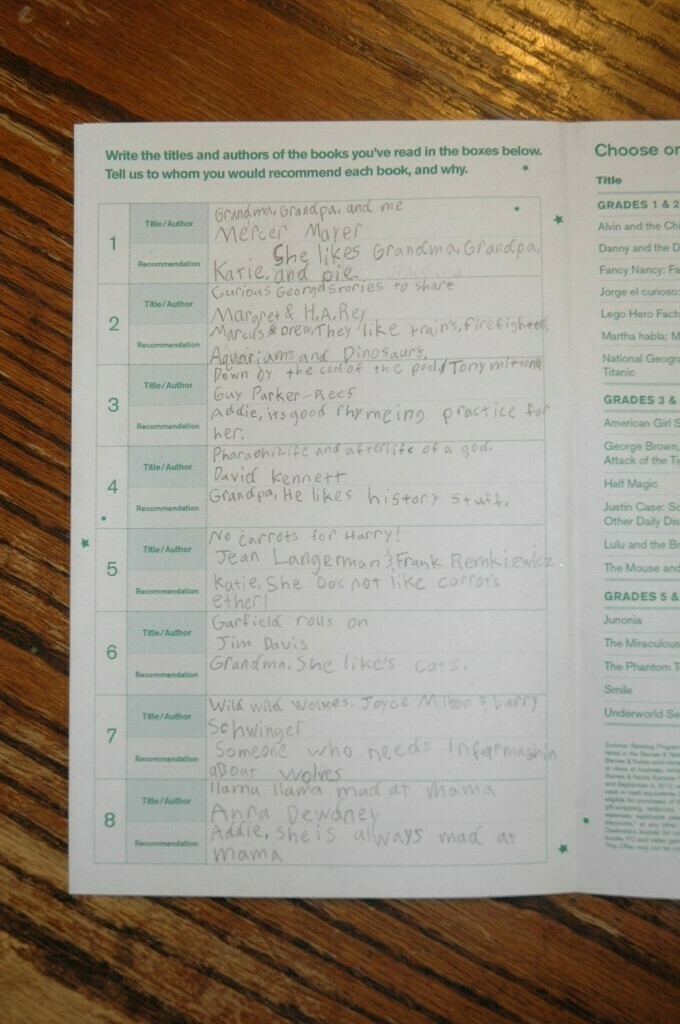
Her recommendations, as she spelled and capitalized them: (For reference, Addie (age 6) and Katie (age 3) are her younger sisters.)
- Book Title / Author: Grandma, Grandpa, and me by Mercer Mayer. Recommended for: Katie. She likes Grandma, Grandpa, and pie.
- Book Title / Author: Curious George: Stories to share by Margret & H. A. Rey. Recommended for: Marcus & Drew. They like train’s, firefighter’s, Aquariums and Dinosaur’s.
- Book Title / Author: Down by the cool of the pool. by Tony Mitton & Guy Parker-Rees. Recommended for: Addie, its good rhymeing practice for her.
- Book Title / Author: Pharaoh. Life and afterlife of a god. by David Kennett. Recommended for: Grandpa, He likes history stuff.
- Book Title / Author: No carrots for Harry! by Jean Langerman & Frank Remkiewicz. Recommended for: Katie. She do’s not like carrot’s ether!.
- Book Title / Author: Garfield rolls on by Jim Davis. Recommended for: Grandma. She like’s cat’s.
- Book Title / Author: Wild wild wolves by Joyce Miton & Larry Schwinger. Recommended for: Someone who needs infarmashin aBout wolves.
- Book Title / Author: llama llama mad at mama by Anna Dewdney. Recommended for: Addie. She is always mad at mama
Priceless.
L'audace, or, he killed a lion in a pit on a snowy day
I don’t often stop to read obituaries any more - lack of a newspaper subscription puts a crimp in that - but there was one this past week that caught my eye, and quickly my attention: the British newspaper The Telegraph’s obituary of Count Robert de La Rochefoucauld of France. Here’s the lede:
Count Robert de La Rochefoucauld, who has died aged 88, escaped from Occupied France to join the Special Operations Executive (SOE); parachuted back on sabotage missions, he twice faced execution, only to escape on both occasions, once dressed as a Nazi guard.
[caption id="" align=“aligncenter” width=“620”] Count Robert de La Rochefoucauld, image from The Telegraph[/caption]
The Telegraph’s account of his life adventures reads like an adventure novel. Raised in French aristocracy. As a boy he met Hitler. During WWII he joined the French resistance, then escaped to Britain and joined the British Special Operations Executive. Parachuted behind enemy lines into France. Escaped captivity twice, once by faking an epileptic fit, killing the guard who came in to check on him, and then walking out of the prison wearing the dead guard’s uniform.
“Audacity” doesn’t even really begin to capture the spirit of Count de La Rochefoucauld’s life. Even as an old man it seems he continued this way. In 1997, when an old war ally was convicted of crimes related to deporting Jews during WWII - a conviction that de La Rochefoucauld believed to be in error - de La Rochefoucauld gave the friend his passport so he could escape to Switzerland.
When I read this obituary it immediately put me in mind of David’s mighty men in 2 Samuel 23 - including Benaiah:
Benaiah son of Jehoiada, a valiant fighter from Kabzeel, performed great exploits. He struck down Moab’s two mightiest warriors. He also went down into a pit on a snowy day and killed a lion. And he struck down a huge Egyptian. Although the Egyptian had a spear in his hand, Benaiah went against him with a club. He snatched the spear from the Egyptian’s hand and killed him with his own spear. (2 Sam 23:20-21)
I’ve gotta admit - it’s just particularly awesome to know that we live in a modern day where there are still people with the audacity and courage to perform feats like these when it becomes necessary. In the adventure of life, we can all take some inspiration from l’audace of Robert de La Rochefoucauld.
Antihistamine Money
Years ago when my family first got a VCR and started renting movies, my dad made a beeline for all of the Rocky and Bullwinkle titles he could find. And for good cause: they are full of the corny jokes and clever puns that my family’s humor has revolved around for years.
(Today all the Rocky & Bullwinkle episodes are available to stream on Hulu. But I digress.)
Out of all the amazing and lame and cheesy puns and jokes from Rocky and Bullwinkle, there was one that has stuck with me to the point that I now use it in every day conversation. The joke goes something like this:
Bullwinkle: Twenty dollars?!? That’s antihistamine money! Rocky: Antihistamine money? Bullwinkle: Yes. It’s not to be sneezed at. Get it? Not to be sneezed at? Rocky: I get it. Bullwinkle: Thousands won’t.
So there you go.
Antihistamine money.
You’re welcome.
The Anxious Christian - Rhett Smith
Sorry for turning this into a book review blog of sorts. One of these days I’m going to get to some more serious posting. For now, though, I’m going to get the books reviewed that I need to. Bear with me.
The subtitle of Rhett Smith’s book The Anxious Christian is either a very silly rhetorical question or designed to feed the anxieties of the target audience. “Can God use your anxiety for good?” Well, of course He can. God’s ability in that regard has never really been in question. If you’re one of Smith’s anxious Christians, though, maybe your anxiety about God’s ability will drive you to buy the book.
Smith uses the early chapters of the book to recount his own struggle with anxiety as a young man. The loss of his mother and several other close relatives at an early age drove him to compulsive behaviors in an attempt to bring some control to his anxious, insecure life. Smith then explores the lessons he has learned from seeing God’s work in his life.
Christians who don’t wrestle with anxiety on a regular basis may immediately point to Phillippians 4 where Paul instructs us to “be anxious for nothing”. Smith addresses this directly in the first chapter, saying that while the instruction is “powerful” and is often counseled by those who “mean well”, we can inadvertently communicate the wrong message.
When we discourage others from safely expressing their anxiety, then we are essentially saying to them that anxiety is a bad emotion, and that it is something to be done away with. It communicates to them that perhaps something is wrong with their Christian faith…
Kierkegaard referred to anxiety as our “best teacher” because of its ability to keep us in a struggle that strives for a solution, rather than opting to forfeit the struggle and slide into a possible depression.
There, in a nutshell, is what Smith is going to come back to in nearly every chapter of the book: to recognize that God is continuously at work in us, and that our anxiety can be useful if it drives us forward to continued struggle and action. He says that God “uses [your anxiety] to awaken you and help turn you toward Him.” In chapter four he goes further to say that “God wants you to pay attention to it [anxiety]. He wants you to listen to it. For in your anxiety God is speaking to you and He is encouraging you to not stay content with where you are.”
In the last few chapters, Smith puts his experience as a marriage and family therapist to good use as he provides some practical suggestions for working in areas that often cause anxiety; he discusses setting good personal boundaries, refining personal relationships, and asking for help.
With a topic like this, an author runs the risk of playing the victim card, but Smith handles it deftly. As one who has struggled with anxiety at various times in my adult life, I appreciated the reminder that God is at work in my life. While I know it to be true, Smith’s book was a welcome kick-in-the-pants reminder.
Note: Moody Press provided me a free copy of this book asking only that I give it a fair review.
The Road Trip that Changed the World - Mark Sayers
Australian pastor and author Mark Sayers put out a request for reviews of his new book, The Road Trip that Changed the World a few weeks ago, and I’m happy today to take him up on it. I had previously read his book Vertical Self and enjoyed it quite a bit, so I was looking forward to his newest offering.
The Road Trip that Changed the World draws its title and chief topic from the classic American novel On The Road by Jack Kerouac. Sayers examines how Kerouac’s novel incited a generation to leave the ideals of home, family, and place and instead to chase the dream of the road, the hope of whatever lays just beyond the horizon.
He spends a good chapter discussing our search for the transcendent, and notes how when we fail to notice and embrace the transcendence in the material here and now, we end up constantly looking for the next “woosh” - a fleeting moment of awe that makes us feel alive but quickly leaves us searching for the next hit.
The first two-thirds of the book is devoted to this examination of the shift in American culture brought on by Kerouac; the last third brings things around to the gospel. Sayers discusses Abraham as “the first counter-cultural rebel”, and traces a path through the Old and New Testaments, ultimately concluding that we need to reject the endless search for the “woosh” over the horizon, instead finding joy and meaning and transcendence in the here and now, as we experience true community and relationship with God.
I’ll say this - Sayers has the spirit of the times nailed. If anything, I didn’t respond to it more because it already seemed so familiar. His diagnosis of cynicism, distance, and the search for transcendence in “woosh” moments is right on. His prescription of embracing community and finding transcendence in experiencing God is a call appropriate for the time. If my cynical generation is willing to hear it, The Road Trip that Changed the World is a great call back to what really matters.
Note: I was provided a free copy of the book in return for reading and posting a fair review.