
Category: Longform
You are viewing all posts from this category, beginning with the most recent.
Cue the Vangelis soundtrack...
One of the enjoyable things about going on business trips to various locations is the chance to get to do some running in locations I don’t usually get to see. I love that running gives you a perspective on a place that you don’t get from just driving past in your car, and when you can get that perspective on someplace new, that’s a treat.
A couple of past favorites include a run around Washington, DC, and another one in Ottawa, Ontario with a short excursion into Quebec. Tonight, though, I got to do my best Chariots of Fire impression on the beach outside of Melbourne, Florida. Can’t beat the sound of waves crashing on the shore as accompianament for your run.
I had to cut the run short because it was getting dark fast, but it was a great run; will definitely have to hit the beach this way again on my next trip to Florida.
The proper evangelical attitude toward sinful behavior outside the church
Here’s one for ya this morning:
The proper evangelical attitude toward sinful behavior outside the church should be one of wise resignation and acceptance. There’s no gospel call to change the world into the church by law. In fact, it cannot be done.
Roger Olson, from How to be Evangelical Without Being Conservative.
I find this thought compelling. It seems so backwards to the evangelical ear, and definitely runs afoul of Dominion Theology, but I think Olson is right.
A Calvinist at the Pearly Gates
Trevin Wax today reviews Michael Bird’s new book Evangelical Theology. Outside of the book and review, this humorous aside from Bird’s book inspired a chortle, which is why I pass it along. Enjoy!
A Calvinist arrives at St. Peter’s gates and sees that there are two queues going in. One is marked “predestined,” and the other is marked “free will.” Being the card-carrying Calvinist that he is, he strolls on over to the predestined queue. After several moments an angel asks him, “Why are you in this line?” He replies, “Because I chose it.” The angel looks surprised, “Well, if you ‘chose’ it, then you should be in the free will line.” So our Calvinist, now slightly miffed, obediently wanders over to the free will line. Again, after a few minutes, another angel asks him, “Why are you in this line?” He sullenly replies, “Someone made me come here.”
Some thoughts on the FAA's decision to allow use of phones/tablets on airplanes from gate to gate
The FAA announced today that it is directing airlines to enact policy that will allow passengers to use their mobile devices (smartphones, tablets, etc) from gate to gate - a welcome change for travelers who are used to the “turn everything completely off until we get above 10,000 feet” announcement at the beginning of every flight.
So my first thought comes as a frequent traveler on this nation’s airlines, and I can summarize it like this:
It’s about time.
But what about the concerns over device usage? The FAA has said for years that they thought it was possible that having phones turned on during takeoff and landing could affect the aircraft. Is that really not the case?
Now, before I start offering opinions, I should explain that I have a little bit of background on this topic. I work for a company that designs and manufactures avionics equipment for big (and small) aircraft. We build things like displays, autopilots, communications radios, and GPSs for just about every aircraft manufacturer you could name. I work in our Certification Department. While my specialty is software certification, I work every day beside men and women who are some of the foremost industry experts in hardware testing relevant to concerns over the use of mobile devices.
Usual disclaimer: all the opinions in this piece are mine, do not necessarily reflect that of my employer, the FAA, or anybody else in the whole wide world.
First off, I’ve had discussions with these guys about the use of mobile devices on board, and they seem wholly unconcerned. That’s a significant data point in my mind. Second, I’ve flown multiple times on our corporate jet with our lead FAA-authorized test pilot flying the plane. Never has he expressed any concern that we make sure our cell phones are turned off prior to takeoff. (I try to make sure to kick mine to airplane mode just so I don’t drain my battery while searching for signal!)
Secondly, I’ve seen the test reports on how this hardware is tested.
Every critical piece of equipment that’s going on the aircraft has to go through a challenging set of qualification tests. The exact tests will be dependent on the how the equipment will be used (for instance, you don’t need a sand test for a box that’s only going to used on the inside of a 747, but you would if it were mounted external on a helicopter), but you’re always going to have to test it for things like vibration, temperature (bake it and freeze it!), and (most pertinent to this discussion) Radio Frequency susceptibility.
I’ve seen the pictures of the test setups, and while I can’t show them to you directly, here’s the general idea of what they do:

In this example, Dr. Doofenshmirtz is the tester, and the unit under test (display, autopilot, etc) is sitting on the table, while Agent P sits there monitoring to make sure it continues to run correctly while the Evil-Inator (or some similar sort of radio transmitter) beams radio waves at it.
(I’m not exaggerating much here.)
To pass these tests, the unit under test must work correctly while being bombarded with a whole range of radio frequencies. If it stops operating correctly, stop the test, update the hardware, and try again.
There’s a reason they test avionics this way, and it’s not because they’re afraid of people who forgot to turn off their cell phones. Airplanes frequently fly past radio transmission towers, and not infrequently through electrical storms. You want to be sure that you’re not going to lose all of your displays and controls even in a freak situation.
The systems design to perform the most critical functions on the aircraft are carefully designed and analyzed to ensure that they will fail no more often than once every one billion flight hours. That’s an amazing standard, more stringent than any other industry, save maybe nuclear. The engineers I know who design systems like our autopilots are some of the finest engineers I’ve ever met.
So suffice it to say I’m not particularly worried about being on a plane where everybody is allowed to have their iPhone or iPad or Kindle turned on during roll-out.
According to that CNN story, Delta Airlines has already filed plans with the FAA to allow their passengers to use devices below 10,000 feet. I’m excited to hear that. I don’t know how fast the FAA will move, but.. I’m flying to Florida next Monday for work, and I’d love to be able to keep reading my e-book or watching my movie from boarding all the way through arrival.
Something to lighten the mood...
It’s been fun as my daughter Laura gets older (almost 9 and a half!) seeing her start to use things like instant messaging to great effect. A year ago she started trying to impersonate her mother while IMing me. (I caught on quickly. Becky doesn’t usually have typos.) A year later, she’s a lot better at the impersonation. (And has a lot fewer typos.)
I totally cracked up tonight when I saw the result of a Skype chat she had with my brother Ryan (who lives in London, England) earlier today. Ryan is well known for his silliness, and Laura comes by it honestly herself. Here’s the result:
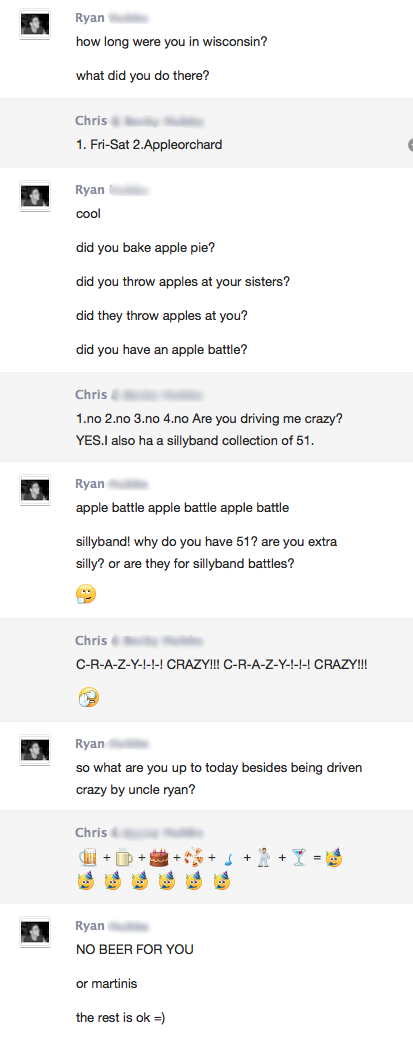
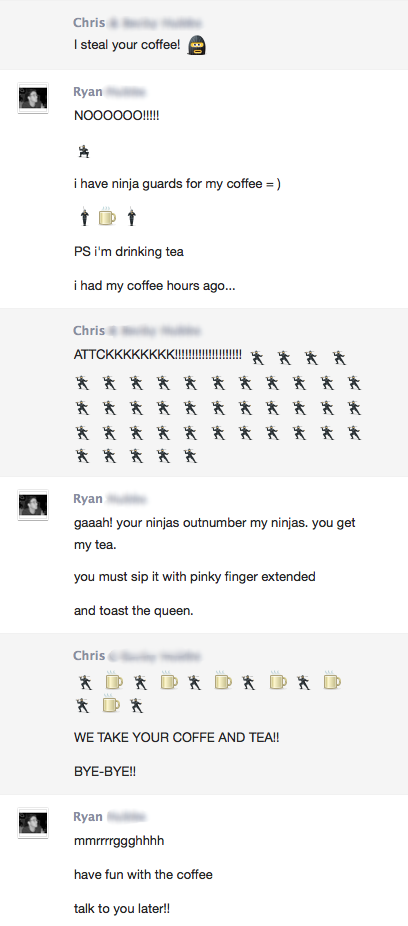
I now know I must employ a sizable number of ninja warriors next time I make a cup of coffee and Laura’s around.
A story of two men
Yesterday I attended a church in another town which I have infrequently visited before. Circumstances allowed me to help lead music as a part of their worship team. After the service I was approached by two different older (60-ish) men. This story is about them.
The First Man
The first man that approached me had given a testimony during the worship service. He was overflowing with contagious joy and appreciation for what God has been doing in his life. While his situation is still not an easy one, he took the time to ask about my family and job, then asked how he could pray for me and proceeded to take my arm and pray right there and then. What an encouragement! As he walked away we both had smiles on our faces and grace in our hearts.
The Second Man
The second man approached me a few minutes later, and after thanking me for my participation, proceeded to tell me that I should be praying for the church. He mentioned his theological training and proceeded to explain how the church would be improved if “they” would “get a vision” for aspects of their ministry that mirrored his. I patiently listened and politely nodded as he went on. When he walked away we both had expressions of concern. His, no doubt, was for that church and its ministries; mine was more for him, who would seemingly look past the good things happening in the church (even that morning!) to “spiritually” complain to a stranger about the church leadership’s vision.
OK, so I lied up in paragraph one. This story isn’t really about them.
As I was thinking over these interactions a day later, the realization hit me like a ton of bricks:
I am the second man.
No, not all the time. And maybe not quite so obviously. But if I think and look back over my past year of on- and off-line interactions, and if I’m honest with myself, I’m the second guy.
I’ve been quick to complain, criticize, and critique. I’ve looked past the good things happening in my own congregation to pick at the nits that I’ve disagreed with. Rather than being thankful for what’s going on, I’ve relied on my “superior” theological knowledge (I am, at best, a well-read amateur) to poke holes too many places where the church didn’t align to “my vision” instead of just helping shore up the walls and foundations that truly might need a little help.
So let this serve as my public apology and repentance. (There are some private ones coming, too.) Where there are still correctives that should be made, may my first reaction always be grace and encouragement, and may I let the correctives wait for the right time and place.
Amen.
(And hey, kick me if you catch me straying from this, eh?)
Clarification, because a couple people have asked: this is a real story, and those were real conversations.
"To be astonishing seems to be the mark of God’s great acts..."
I’m sure I heard the name Marilynne Robinson several years ago when her novel Gilead won the Pulitzer Prize. She does live just down the road in Iowa City, after all. As I recall I even borrowed the book from the library and got bogged down in it pretty quickly. (Maybe I wasn’t ready for it a decade ago.)
Then last year on a whim I borrowed When I Was A Child I Read Books from the library; a slim volume of essays that turned into one of my favorite reads of the year. (I need to go back and read it again.)

Robinson’s writing reveals her as a delightful conundrum theologically. Raised Presbyterian, now part of the United Church of Christ, yet rather than embracing the theological ambiguity of the UCC she speaks fondly of John Calvin, clearly takes the Scriptures seriously, and reveals a deep humanism and care for people created in God’s image.
A recent interview of Robinson by The American Conservative prompted me to write this post, and it’s definitely worth a read. Robinson stakes her claim to ’liberal Protestantism’ that she describes as being ‘grounded in Calvinism’.
When asked her thoughts about the association of Christianity with the American right-wing, she said this:
Well, what is a Christian, after all? Can we say that most of us are defined by the belief that Jesus Christ made the most gracious gift of his life and death for our redemption? Then what does he deserve from us? He said we are to love our enemies, to turn the other cheek. Granted, these are difficult teachings. But does our most gracious Lord deserve to have his name associated with concealed weapons and stand-your-ground laws, things that fly in the face of his teaching and example? Does he say anywhere that we exist primarily to drive an economy and flourish in it? He says precisely the opposite. Surely we all know this. I suspect that the association of Christianity with positions that would not survive a glance at the Gospels or the Epistles is opportunistic, and that if the actual Christians raised these questions those whose real commitments are to money and hostility and potential violence would drop the pretense and walk away.
Strong stuff. And I love the spirit of what she says when asked about her views of the Second Coming:
I expect to be very much surprised by the Second Coming. I would never have imagined the Incarnation or the Resurrection. To be astonishing seems to be the mark of God’s great acts—who could have imagined Creation? On these grounds it seems like presumption to me to treat what can only be speculation as if it were even tentative knowledge. I expect the goodness of God and the preciousness of Creation to be realized fully and eternally. I expect us all to receive a great instruction in the absolute nature of grace.
I went to the library yesterday and picked up a copy of Gilead. It’s time to give it another try. Then it’s time to go back and find Robinson’s other novels and essays. We are blessed to have a thinker and writer of Robinson’s grace and skill sharing with us.
Losing something in the modernization
This past Sunday our worship team learned and led a new (old) song - Chris Tomlin’s arrangement of (and new chorus for) the old hymn Crown Him With Many Crowns.
On the whole, I like it. If adding a contemporary chorus is what it takes to get us singing two and a half verses of densely-packed truth in a classic hymn, that’s a deal I’m willing to make.
Aside: the density of theological truth in this old hymn, when compared to what’s in most modern songs, is really stunning. But that’s a post for another time.
The one quibble I’ve got with Tomlin’s update to the hymn, if you’ll allow me to be pedantic for a minute or two, is in the updates to remove the archaic articles. Now, I’m not, in principle, against removing them. Thee, Thou, and Thy aren’t in common usage any more, and a careful update can give the classic text a fresh new feel. But the changes here aren’t so careful, or at least they’ve sacrificed accuracy in favor of rhyming schemes. A couple of examples:
From Verse 1, the original:
Awake my soul, and sing Of Him who died for Thee And hail Him as thy matchless King Through all eternity
And the update:
Awake my soul, and sing Of Him who died for me And hail Him as thy matchless King Through all eternity
That second line is a challenge to modernize, because getting lines two and four to rhyme really depends on having that long E sound at the end of line two. And replacing “thee” with “me” doesn’t actually change the theological content in any particularly objectionable way.
But it changes the perspective of the verse. In the original, the author calls his soul to sing, because Jesus died for his soul. In the update, the soul is called to sing because of the salvation of the author. A minor difference, but (at least to me) frustratingly annoying.
The second issue comes in what was the tail end of the fourth verse in the original, but which Tomlin has repurposed as a bridge in his version.
The original:
All hail, Redeemer, hail! For thou hast died for me; Thy praise and glory shall not fail throughout eternity.
And the update:
All hail, Redeemer, hail! For He has died for me His praise and glory shall not fail Throughout eternity.
And it’s the same problem - what the heck do you use to rhyme with eternity? A friend on Facebook pointed out that the problem (quite obviously, upon reflection) isn’t with rhyming ’eternity’. Doh!
This time I dislike the solution quite a bit more, because it changes the direction of the lines. In the original hymn, the hymnwriter turns to address Christ directly at the end. “All hail, Redeemer, hail! You have died for me!” But the reworking turns it into an account of Christ’s work rather than a direct stanza of praise.
Again, it’s still not wrong, but it really loses something in the translation.
OK, yes, I’m being pedantic. I’m still happy we sang the song, and I hope we include it in our regular song rotation. But I’m also still tempted to conclude that maybe the better lesson for the modern church would be to learn to sing and appreciate some of these classic hymns without forcing them to fit our modern musical sensibilities. Or maybe I’m just getting crotchety in my late 30’s.
I Rest in the Grace of the World
When despair for the world grows in me and I wake in the night at the least sound in fear of what my life and my children’s lives may be, I go and lie down where the wood drake rests in his beauty on the water, and the great heron feeds. I come into the peace of wild things who do not tax their lives with forethought of grief. I come into the presence of still water. And I feel above me the day-blind stars waiting with their light. For a time I rest in the grace of the world, and am free.
--“The Peace of Wild Things” by Wendell Berry
[I needed this today. HT: Richard Beck]
The proper format for a sermon
A good insight here:
…a genuine sermon must begin with the first proclamation, with the proclamation of salvation. There is nothing more solid, deep and sure than this proclamation. Then you have to do catechesis. Then you can draw even a moral consequence. But the proclamation of the saving love of God comes before moral and religious imperatives. Today sometimes it seems that the opposite order is prevailing.
You’ve gotta love this.
First proclaim the gospel, the truth of God’s love and salvation.
Then do your doctrinal teaching.
Then draw a “moral consequence” - the “what to do”.
But get the order right.
This is just one piece of the wisdom from Pope Francis, as documented in this recently-published interview. It’s long, but a remarkable and highly-recommended read.