
Category: movies
You are viewing all posts from this category, beginning with the most recent.
”You better hold on to something” - a few thoughts on Train Dreams
I’ve been trying to see all the Best Picture nominees before the Oscars go out, and tonight I caught up with Train Dreams. What a beautiful movie. A few random thoughts, in which I will probably have spoilers so if that bothers you, don’t read on until after you see it:
“The world needs a hermit in the woods as much as a preacher in the pulpit.”
First, I’m not familiar with the novella the movie is based on. Feels like I need to correct that oversight. The movie’s storytelling is spare and restrained, which I appreciated. I’d heard chatter about it being a very sad movie, and I honestly wasn’t quite ready for another gut-wrencher after watching Hamnet. Yes, Train Dreams is sad, but the first word I’d use isn’t so much sad as haunted. Joel Edgerton’s eyes capture a world changing faster than he is able or willing to adapt, a world haunted by his own dreams and memories of loss, failure, and regret.
“The world’s an old place. Probably nothing it hasn’t seen by now.”
If you’d asked me to name the movie’s time period during the first half of the film, I was ready to put it in the mid-to-late 1800s. (I may have missed a bit of the initial narration if they clarified it there.) So the advancing technology – the chain saw, the highway, the astronaut! – illustrated Edgerton’s character even more starkly back in the past. How quickly time moves.
Train Dreams’ casting was exquisite. In addition to Edgerton, Daisy Ridley and Kerry Condon comfortably inhabit the only two female roles (it is the western wilderness, I guess) and Will Patton’s gentle narration threads the story together. And then there’s William H. Macy. I’ve seen and loved Bill Macy as a hapless car salesman, a deadbeat addict father, a random collection of military officers, and sad casino jinx. But philosopher coot wilderness logger Bill Macy may well be my favorite Bill Macy. Perfectly cast, and oh-so good in the role.
Arn (Macy): What’s keeping you awake over there?
Robert (Edgerton): Oh, uh… Arn, do you… do you think that… the bad things that we do follow us through life?
Arn: I don’t know. I’ve seen bad men raised up and good men brought to their knees. I reckon if I could figure it out, I’d be sleeping next to someone a lot better-looking than you.
Train Dreams is gonna stick with me for a while. In the pointed final sequence, Edgerton’s character, about to do a loop in a biplane, is warned “you better hold on to something”. As he remembers the things in his life he has, indeed, held on to, the narrator tells us that he finally felt connected to it all. In our own unmoored lives in the midst of a rapidly-changing world, we, too, might benefit from reflecting on who and what we are connected to.
Worth a watch: Thelma
Thanks to a couple online recommendations (for sure Jeffrey Overstreet, I don’t remember who else), Becky and I took the two younger kids along to see Thelma this afternoon.
Grandma gets scammed, and decides to take matters into her own hands. It’s a delightful movie. Moves briskly, treats its characters respectfully, is both heartwarming and hilarious. June Squibb turned 93 while making this film, and she uses that age and experience to great effect here. Richard Roundtree co-stars and their chemistry is just perfect.
Grab a loved one, go see Thelma, and prepare for a fun 100 minutes.
Carter Burwell: polymath film composer
I was familiar with Carter Burwell’s name thanks to his score for the Coen brothers’ film True Grit, but I wasn’t aware of the full scope of his film compositions or of his backstory. A brilliant man who just picked up and learned lots of things. Just out of college and trying to make it as a musician while working a lousy warehouse job:
One day, Burwell saw a help-wanted ad in the Times for a computer programmer at Cold Spring Harbor Laboratory, a nonprofit research institution whose director, James D. Watson, had shared the Nobel Prize in 1962 for discovering the structure of DNA. Burwell wrote a jokey letter in which he said that, although he had none of the required skills, he would cost less to employ than someone with a Ph.D. would. Surprisingly, the letter got him the job, and he spent two years as the chief computer scientist on a protein-cataloguing project funded by a grant from the Muscular Dystrophy Association. “Watson let me live at the lab, and he would invite me to his house for breakfast with all these amazing people,” he said. When that job ended, Burwell worked on 3-D modelling and digital audio in the New York Institute of Technology’s Computer Graphics Lab, several of whose principal researchers had just left to start Pixar.
The Polymath Film Composer Known as “the Third Coen Brother” by David Owen in The New Yorker
His royalties from scoring Twilight funded a house on Long Island, where he lives and works from home, composing on a 1947 Steinway D that came from the Columbia Records studio in New York. “I still fret about having replaced the hammers, but they were worn almost to the wood—some say by Dave Brubeck.”
Worth reading the whole profile.
Quick Thoughts after watching Top Gun: Maverick
Mild spoilers ensue.
- This is basically the most 1980’s war film you could make in the 2020s. All the sunsets and American flags.
- Owes plenty to Star Wars. Flying the trench to hit a 3-meter target without the use of your targeting system? Enemy fighters wearing faceless black helmets as they piloted their superior craft? Mobbed by jubilant crew members as you exit the fighter after returning victorious? The only thing missing was a princess to hand out medals afterward.
- There was a little Tom Cruise greeting to moviegoers that played before the movie. Cruise looked much older in that greeting than he did in the film. He’s aging sort of Robert Redford style.
- Movie relies heavily on slow, lingering golden hour shots of Tom Cruise and/or Jennifer Connelly in a medium shot. I mean, they’re both pretty people, so it’s not all bad.
- Pretty sure if you took all those lingering shots out the movie length would cut down from 2:10 to something like 1:30. OK, maybe 1:45.
- In the initial shot where Cruise is shown a roster of pilots he will train, Manny Jacinto’s (Jason Mendoza from The Good Place) face is in the top-left corner. Jacinto is nowhere to be found in the rest of the movie, though. Poor guy got left on the editing floor I guess.
- I hadn’t realized that Val Kilmer was so ill. His whole plot line was weak - he is introduced as COMPACFLT who brings Maverick in, then his cancer is back but “nobody knows”, even though he’s an invalid and can’t speak, and then he dies and is buried within the next week? Plenty of the movie beggars belief, but that thread was the worst.
- On the whole it was lightweight fun - worth watching on the big screen, not worth watching a second time.
Knives Out
Took the family to see Rian Johnson’s latest film, Knives Out, this afternoon. I know Johnson is a big-name filmmaker at this point - writing and directing an episode of the Star Wars franchise will do that for you. But I still feel like I knew him back when, thanks to the guys on the Filmspotting podcast championing his work from the very beginning. Having watched Brick, The Brothers Bloom, and Looper, I had a good feeling about The Last Jedi, and when Knives Out was announced, I was ready to buy tickets immediately.
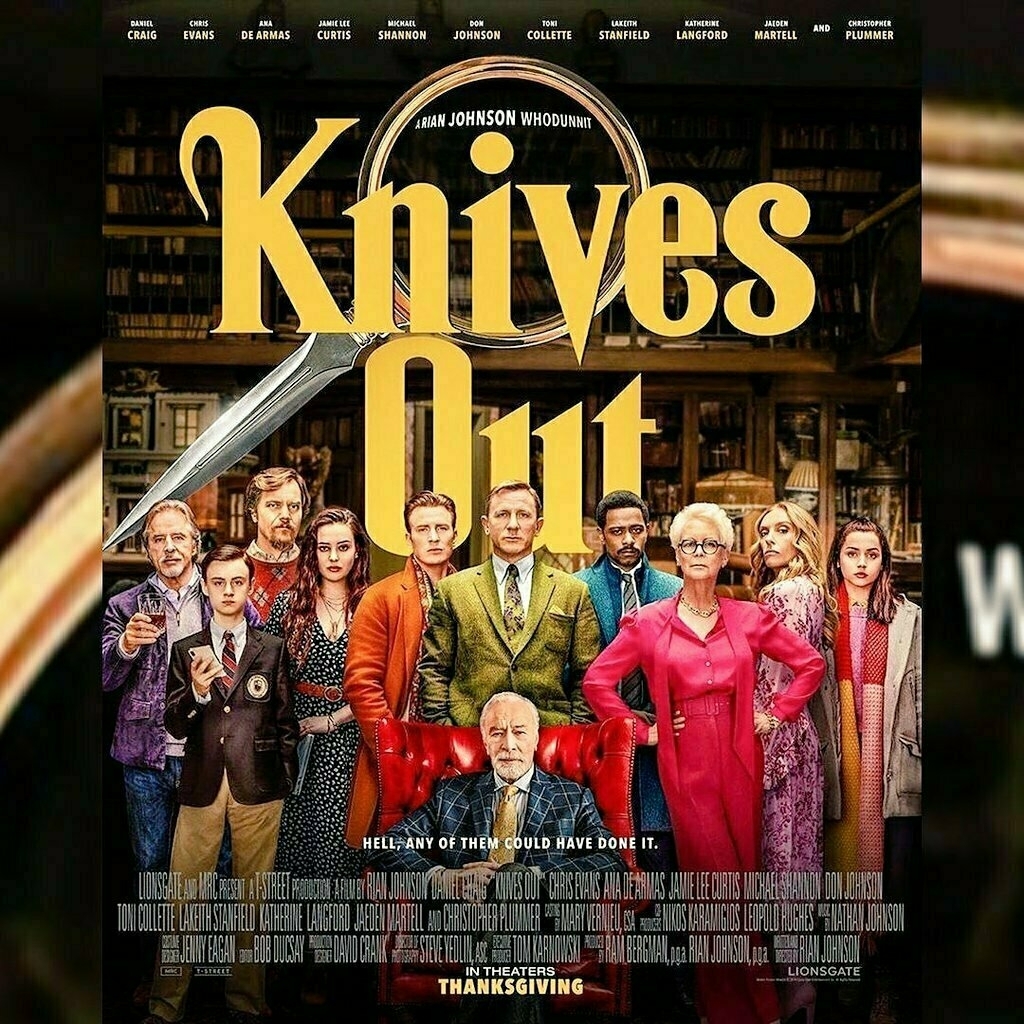
Knives Out is Johnson’s take on the whodunnit genre, a la Agatha Christie. That means to avoid spoilers I shouldn’t really say anything more about it. But I have a few non-spoilery thoughts.
First: Rian Johnson is a master of taking genre movies bending the genre ever so slightly for a knowing audience. He did it with film noir in Brick, and with time travel movies in Looper. Suffice to say he does it again masterfully here in Knives Out.
Second: That closing shot is the best I’ve seen in years. It’s just perfect.
Finally: now knowing how it ends, I really want to go watch it again to see how much it telegraphed early on that I completely missed. Johnson is careful enough that I doubt there are many (any) loose ends.
Frozen II: A Very 2019 Movie
It’s been just long enough since the original Frozen came out, and my girls have aged just enough, that we didn’t end up at the theater on opening night for Frozen II. But by Sunday afternoon we decided to brave the horde of preschoolers and their parents. The older two probably felt a little too old for it. The youngest, though, was first in line to get in the theater door, and was on the edge of her seat in excitement for the whole show.

Frozen II is quite clearly a Disney mega-picture. More of what worked from the first one: comical Olaf the snowman; genial Kristof voicing his reindeer’s thoughts; the briefest cameo from Oaken who has exited the spa and is now giving manicures. The new songs weren’t as catchy as those from the original - they felt much more like Broadway narrative than tidy pop songs. Frozen II isn’t the timeless classic that its predecessor was, but it is very much a movie for our time - a very 2019 movie.
(Spoilers to follow…)
Let’s start with the main plot of the movie. Elsa discovers that her grandfather brought modern technology (in this case, a river dam) to the indigenous northern peoples only to betray them. Two generations later, that technology is ruining the land and imprisoning the people who live there. Elsa and Anna determine the only solution is to tear down the dam, regardless of the potential cost to their city. Can you hear the echoes of our growing American recognition of the evils of Columbus and the slave trade?
Then there’s dear, naive Olaf, singing about how he’s young now and the world doesn’t make sense, but that he’s so glad it’ll make more sense when he gets older. Yeah, Olaf, keep hoping.
If the grim hopelessness of a confusing world gets too tough, don’t worry - there’s 4 minutes of humor and irony directly ahead. Kristof needs a song too, after all. What he gets is a send-up of every late 80’s power ballad music video ever, complete with the fade-ins and -outs, shadowy reindeer backup singers, and soulful guitar solos. This scene is going to seem dated pretty quickly as the movie ages, but for now the irony is thick and aimed directly at the parents who will sit through this thing a million times once it comes to Disney+.
Perhaps the most helpful and hopeful theme from Frozen II is another thought aimed right at the heart of 2019. Through the movie, both Anna and Elsa come upon situations that seem bigger than they can handle. They want to solve problems but the problems seem insurmountable. Whatever should they do? And then the old wisdom comes to them: “do the next right thing”. You may not be able to see the end yet. But look around for the right thing to do… and do it. Overly simplistic? Maybe. But maybe not terrible advice for citizens of 2019, either.
I came home from Frozen II thankful that there’s no equivalent to “Let It Go” to become the soundtrack in our house for the next year. (And also realizing I should show my kids a Richard Marx video so they get the spoof.) At a cinema where the adjoining screens were showing a woke remake of Charlie’s Angels and a movie about Mr. Rogers, Frozen II fits right in as a product of, and a message for, an audience weary of 2019.
Family Movie Night: Chain Reaction (1996)
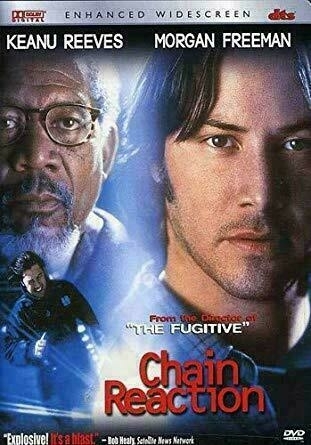
With a kid under the weather after some dental work, it was a good night for a family movie. The library provided the convenient loan of a nostalgia pick for Becky and me: Chain Reaction, the 1996 film starring Keanu Reeves, Morgan Freeman, and Rachel Weisz.
If you’d asked me before I looked it up, I would’ve guessed this came out when I was still in high school, since I remember watching it a handful of times back in what feels like that timeframe. But, since it came out in ‘96, I probably watched it for the first time at the dollar theater in Longview, TX while I was in college, probably with Becky along on a cheap date.
My first thought when starting the movie was “wow, this reminds me in a lot of ways of The Fugitive”. All the Chicago scenery, a bunch of the same guys playing Chicago cops, familiar shots of midwestern woods and small waterways… then I looked it up on IMDB and quite belatedly realized that Andrew Davis directed both movies. No surprise then, that they look the same.
The plot is about as spare as I remember it - Reeves’ team makes some scientific breakthrough to generate cheap electricity from hydrogen, and his lab is blown up before they can publicize. Morgan Freeman is the shifty leader of the foundation providing Reeves’ funding, who may or may not be bankrolled by the CIA. That’s about as much plot as you need, as the middle of the movie ends up being a series of chases across a drawbridge in downtown Chicago, a frozen lake (with a fan-powered airboat!) in Wisconsin, and through the Natural History museum in Washington DC.
Chain Reaction is innocuous enough, drawing just enough charisma from Morgan Freeman and enough action through the Chicago landscape to keep the family at least mildly interested for 100 minutes. I was surprised at how much of it I remembered, having not watched it for more than a decade.
Mostly, though, now it just makes me want to watch The Fugitive. Same Chicago chase scenes, but Tommy Lee Jones and Harrison Ford as the cat and mouse… if only they’d had a role for Morgan Freeman in it, they might’ve really had something.
I know nothing about this movie other than what’s in this trailer...
But I would buy a ticket right this minute if I could.