
Category: Longform
You are viewing all posts from this category, beginning with the most recent.
My trip to India, Day 1/2
I’m in Hyderabad, India this week for work. (I’ll be teaching a training class all week for the employees of our Indian office.) Rather than post this as a series of tweets that nobody is going to read because I’m 12 hours ahead of them, I’ll scatter my thoughts on the blog.

I left Cedar Rapids at 1pm Iowa time on Friday afternoon. From there I went through Detroit and Amsterdam to get to Mumbai. Overnighted in Mumbai, then caught an early flight to Hyderabad. Got to the hotel about 10:00 AM India time on Sunday, which is about midnight Saturday night/Sunday morning back home. 36 hours of travel. Oof. Business class is great, but it doesn’t make the flights any shorter.
OK, I just threw away 200 words of travel narrative because I was getting tired of it, and if I was, all of you will. Instead I’m gonna do bullet points.
- Having a hotel car pick you up from the airport is the way to go. Indian road markings, signs, and signals are suggestions as best. Traffic negotiation appears to be done primarily with horns and flashing headlights.
- Didn’t see much of Mumbai - arrived and left when it was still dark - but the airport was gloomy and damp. As was the hotel.
- The difference between Mumbai and Hyderabad was stark. The Hyderabad airport is a lot newer and more modern, and it’s clear that Hyderabad has put in, and continues to put in significant effort into modernizing. It appears that they want to be known as the tech-friendly, environmentally-conscious city.
- There were people out along the major freeway in Hyderabad this morning planting hundreds of little trees to line the roadway. Which also meant lots of little piles of dirt in the right-hand lane and people standing in the road shoveling.
- The sheer number of people everywhere is overwhelming. Even at the hotel, in each public area they have a bazillion employees there to offer you assistance with every little thing. (A guy had to come out and spread a pool towel on the deck chair for me before I could sit down on it. I mean, come on.) For an introvert like me who likes to just figure things out on my own and be left alone, it’s exhausting.
- On that point, why doesn’t the hotel here have a comprehensive information book in the room? In the states, we’d have a book that gave all the details for the hotel, when the restaurants were open, amenities, etc. Here apparently I have to ask somebody. (See preceding point.) Once again: exhausting.
- After 48 hours of travel, I’ve gained an entire extra level of appreciation for Bill Murray’s world-weary role in Lost in Translation. What time/day is it again, anyway?
So that’s days one and two of my India trip. I’ve got 45 minutes more to wait before the hotel restaurant opens and I can get some dinner to try to help reset my body clock. Then it’s off to dreamland, and the first of four full days of teaching classes tomorrow.
In an alternate universe...
Twitter was abuzz with #Hutchmoot tags yesterday after Andrew Peterson’s announcement of the special guest for this year’s Nashville faith and arts conference: singer/songwriter Rich Mullins. Mullins, 57, had big Christian music hits in the 1990’s with “Awesome God” and “Sometimes By Step”, has been nearly unheard from since the release of “The Jesus Record” in 1997.
Mullins has spent most of the last decade on a Navajo reservation in New Mexico, continuing to teach music lessons to children and reportedly working on a memoir. It’s not immediately clear what prompted Mullins’ desire to jump back into the music world by attending Hutchmoot.
“I was stunned to get the phone call”, said Hutchmoot organizer Andrew Peterson. “Rich has been an inspiration to me for decades. Rich’s music is the common fabric that inspired so many of us who write at The Rabbit Room and who record as the Square Peg Alliance. It’s a great honor to have him join us and share at Hutchmoot this year.”
Adding to the Hutchmoot buzz was a tweet from long-time Mullins producer Reed Arvin (@reedarvin) who said yesterday “Exciting phonecall from an old friend. Can’t produce this time but he couldn’t have picked a better producer.” This was followed, ten minutes later, by a single-word tweet from Andrew Peterson collaborator, pianist and producer Ben Shive (@benshive): “Speechless”.
Tickets for this year’s Hutchmoot have long been sold out, but Rabbit Room proprietor Pete Peterson notes that he is keeping a waiting list if there are any last-minute cancellations.
-———–
Rich Mullins passed away as the result of a car accident 15 years ago today. Those of us who grew up loving Rich’s music are forever in his debt. We miss you, Rich. Rest in peace awaiting the resurrection.
Standing Desk Update
It’s been a little over a month since I began using a standing desk at work.

So how’s it going after a month? Pretty well, actually. Some observations:
- My back, arms, and shoulders are a lot less sore at the end of each day. I’m tall (6-4) and squishing myself under a desk all day just wasn’t good form. Standing up is a lot better.
- My legs are slowly getting used to it. The first day I stood up all day I was definitely ready to get off my feet at the end of the day.
- I got a standing mat that helped a lot. Having 3/4-inch of foam between my feet and the floor really helps.
- I learned really quick which shoes are comfortable (my Merrell Road Gloves are awesome) and which ones are not (my cheap black dress shoes).
- My co-workers were amused, interested, and curious. I don’t know that any of them will take up the trend, but many of them observed that it might be a nice change. (It’s also possible they were just being polite and really think that I’m a weirdo.)
I’m planning on sticking with the standing desk for the time being. If I’m still gung-ho about it after, say, Christmas, I might start pursuing the possibility of getting a real standing desk via the regular work channels. I understand they have one that is electric and adjustable, which would be nice. It’d also be nice to bring all of my work surface (not just my monitors and keyboard) up to standing level.
Andrew Peterson - Light for the Lost Boy
Andrew Peterson’s new record, Light for the Lost Boy, came out last week, but a business trip and a busy weekend conspired against me. So, my first listen to the record didn’t come until this morning. There is so much I could say about this record that I don’t even really know where to begin.
Great records seem to come out of pain. Much as I love Peterson’s earlier records, they’ve succeeded due to their beautiful melodies and tightly-crafted lyrics. The truth is present in his word-art, but it hasn’t as often fully resonated with the deep soul ache of a man wrestling with the fallenness of the world and the goodness of God.
Light for the Lost Boy, though, changes all that. From the opening line of the record (“I remember the day of the Tennessee flood…”), Peterson examines the fallen beauty of the world, the joy of childhood, and the loss of innocence that comes as we grow up. (I’d highly recommend Jonathan Rogers’ piece on this record over on The Rabbit Room. Jonathan says it way better than I can.)
In “The Cornerstone”, he examines the experience of colliding with Jesus in a life-changing way. “The Voice of Jesus” sits in contrast as a lullaby to a child, recognizing how God speaks to her through “the ache in your bones”. The final track, “Don’t You Want to Thank Someone?” is epic in length (9 minutes 57 seconds!) and in scope, tracing the course of human history from the goodness of creation through the fall and finally to the ultimate reckoning.
Sonically this record breaks some new ground for Peterson. While some tracks (including the official pre-release, “Rest Easy”) will sound familiar to the ears of long-time Peterson fans, at least half of the record builds energy with electric guitars and electronic beats. While the record was produced by Ben Shive and Cason Cooley, the opening track had me thinking that my friend Andy Osenga had a hand in it. (The song “Carry the Fire” is AP’s nearly exact corollary to Andy O’s “Hold The Light”. This is a good thing.)
If it isn’t clear enough from my review already, Light for the Lost Boy is highly, highly recommended. It would be presumptuous of me to declare it my new favorite Andrew Peterson record after only one listen. However, given that after one listen I can remember every song and a particular way that it stuck with me, I think that future listens (of which there will be many) will only cement this record as a long-time favorite from Peterson.
You can buy the record from The Rabbit Room, or on iTunes.
Single Payer
I was stuck in a hotel last night watching Paul Ryan’s speech, and after he ripped on Obamacare, I had to comment on twitter:
Fellow BHT patron (and, so far as I can tell, staunch conservative / libertarian) Randy replied this morning. twitter.com/rmcrob/st… twitter.com/cjhubbs/s… twitter.com/rmcrob/st… twitter.com/cjhubbs/s…
So, stuck in another hotel room tonight (headed home tomorrow, thank God), as promised I want to write down some thoughts about single payer health care.
I’ll lay out my disclaimers out front: I haven’t done a lot of research on this. I’m shooting more or less from the hip. I’m not a doctor, nor do I have experience with the medical industry, save as an infrequent consumer.
So, about single payer… Maybe I should be a good engineer and first define what I mean by “single payer” health care. I use the term to describe a system where the government provides the funding for the health care system in the country, paying for services directly. Examples of single payer systems include the British National Health Service, and, to an extent, the Canadian health care system.
Why might single payer be a good idea?
Lower costs It’s a fair question: do we really think government is the most efficient way to run things? But let’s face it: the current system isn’t efficient. Administrative costs eat anywhere between 10 percent (if you believe the insurance agencies) and 30 percent (per a Harvard Medical School report) of the total health care dollars in the US. With $2.26 trillion dollars spent each year in the US on health care, percentage gains for administrative overhead will equal savings. Think about the number of insurance companies and billing middle-men that can be avoided in a single payer system.
Better understanding of actual costs
Any time I look at a bill received from the doctor I realize there are a bunch of shenanigans going on with the pricing of health care. The “list price” for a procedure (i.e. the price I would pay if I didn’t have insurance?) is really high. But then there’s this “negotiated” price listed. Which is a lot less. And I only have to pay a percentage of the “negotiated” price. It’s bizarre and hard to explain.
It works other places
Republicans will tell you anecdotal horror stories about the British or Canadian health care systems, but in the less-biased opinions of my British and Canadian friends, those systems actually work decently well. They’re not perfect, but they’re not atrocious, either. It’s doable.
It’s different than housing and transportation
Randy asked why, if we’re going to go the public funding route, don’t we also publicly fund other needs, like housing and transportation?
First off: we often do. It’s called public housing assistance, and public transportation.
Second off: health care is a different sort of beast. Lack of basic health care can be the reason that poor people are physically unable to work a job. A preventable dental condition or disease can be the difference between being able to show up to work and having to stay home.
The Social Contract
Whether you fully buy in to Thomas Hobbes’ idea of the Social Contract or not, I think he got at least one thing right: that there are certain ills which the government is the appropriate remedy, and that citizens should agree to give up some freedoms to that government in return for the benefits it provides.
Heck, even the Apostle Paul (Romans 13) notes that God designed government to “wield the sword”, so it seems that God isn’t completely opposed to governments.
Reading the Old Testament (and the New), it’s also clear that God places priority on caring for the poor, and in treating all classes and races of people with justice and mercy. The Marilynne Robinson essays I read a couple weeks back spoke strongly on that topic, noting that the OT law is designed in multiple aspects to protect the poor and the week, by outlawing usury, time-limiting slavery, and forgiving debts in the jubilee year.
As the people of God, I believe we should value justice and mercy more than personal freedom and rights. Perhaps our Christianity has been tied to our politics for so long in the USA that we’ve forgotten that the church has flourished over the years under many different political theories and types of government. America’s version of democracy may have attractive features, but it’s not God’s only righteous design for governments.
Shouldn’t the church do it?
I’ve been down this discussion path enough times before that I know the next objection that gets raised: “it’s the church’s responsibility to care for the poor, not the government’s.”
To which I say great, if the church can fund it, let’s go for it. But if you look at the money that each church would need to raise in order to start covering things like welfare and health care, you’d quickly exhaust the coffers of every congregation in the country. The church simply does not exist as a significant enough percentage of the population for this to be feasible.
Yes, the church should give funds to care for the poor when they can. (And probably more than most of them currently do.) But it’s not a logical jump to assert that the church is the only group that should do it.
OK, that’s a lot of words already… get to the point!
When I boil it down, I conclude that if a society values justice and mercy toward all, ensuring provision for basic health care is a necessity. If I have to choose between the current unjust mess that we’ve got, and a system that, while run by the government, provides care for all, I’ll support the government-run plan.
For an equally-lengthy, but much-better-put piece on this topic, I’d encourage you to read Michael Bird’s piece from back in June over on Patheos.
Three careers I could've pursued but didn't
I’m sitting in a hotel room in Florida tonight, bored and needing blogging inspiration. So I hit up twitter. Two minutes later my buddy Geof primes the pump: twitter.com/gfmorris/…
So, three careers I could’ve pursued, but didn’t. Here’s your chance to get to know a little more about me.
Career option #1: musician
My first love has always been music. I’ve played the piano since I was in second grade, play guitar and bass, love classical, jazz, rock, and most stuff in between. One of my greatest joys is playing with a talented group of musicians. There’s an amazing convergence of mental pleasure in playing some piece of music as a part of a group - everybody contributing their own part to make the whole - and an emotional rush from the beauty of the music itself.
[caption width=“500” align=“aligncenter”] Could I have been this guy? Nah, I could never pull off that haircut.[/caption]
I considered some music options while I was in high school, but never really committed to the idea. I suppose I never really had a good idea about what the heck I would’ve done with it. My dad had been a high school music teacher, but his recommendation was to do something else - something that would be easier to provide for myself and a family. I don’t resent his advice at all or regret heeding it - I’ve got no complaints about where I am now - but sometimes I wonder what alternate path could’ve occurred if instead of going to LeTourneau I’d gone to Belmont to do something music related. I would’ve been there about the time Andy Osenga and Cason Cooley were deciding to quit school to do this band called The Normals, and when Ben Shive was skipping finals to write string arrangements for Andrew Peterson’s Christmas album.
Career Option #2: Pastoral ministry
I’m a bookish, nerdy guy. I like theology. I like to study and wrestle with issues. There was a time in high school when I thought the pastorate was the way to go. Relevant advice I received from two different pastors over the years: “if you can do something else, do it. Only be a pastor if you’re so called to it that you can’t do anything else.”
[caption width=“328” align=“aligncenter”] My church doesn’t have stained glass. I kinda miss it.[/caption]
In retrospect, it’s probably just as well I didn’t go this route. Though I continue to love theology and exploring my faith, I’m such an introvert that I think the personal aspects of pastoral ministry would completely wear me out. I enjoy the opportunities to be in church leadership in a role as a layman; making a career out of it probably wouldn’t be a good thing.
Career Option #3: OK, this one is a cheat.
I never seriously considered this one as an option, but I’ve idly thought about it as a path I would enjoy following in some alternate universe: I’d like to be a professional baseball umpire.
[caption width=“500” align=“aligncenter”] Time to get in the zone.[/caption]
I love the game, have a keen enough mind that I might be able to absorb the intricacies of the rulebook, and might just be able to hold my own in making the judgment calls. I might be a little bit tall to be an umpire - most MLB umpires are under 6 feet, making it easier to squat down to call balls and strikes - but maybe I could make it work. I hear the minor league circuit is pretty brutal on umps, though, so it’s not as if it’s a particularly glamorous job, and there aren’t a lot of openings at the top level. Still… it’d be fun.
So thanks, Geof, for the topic. I’ll go peruse twitter now and see if there are any other good ideas floating around there.
I just wanna be Andy Gullahorn
I’ve gone through a lot of wanna-be stages in my life as a musician. My mother listened with horror while as a teenager I tried to imitate Michael W. Smith’s raspy pop voice. Then I fell in love with Rich Mullins and worked out all of his piano riffs. I’ve dreamed about playing electric guitar with U2 (I know, they already have a guy), saxophone in Harry Connick’s band, and replacing another guy named Chris who fronts for Coldplay.
I think I’ve finally settled on a wanna-be now, though. I just wanna be Andy Gullahorn.
You may not be familiar with Andy, so let me introduce you.
Andy Gullahorn is a tall, quiet, guitar-playing Texan who writes songs and plays guitars for lots of folks. I’ve most often seen him on stage adding a second guitar for Andrew Peterson.
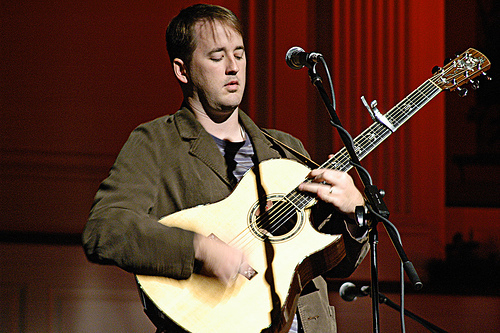
Andy is a man of few words. Seemingly every time he takes the mic to sing he stares awkwardly at the crowd, finally saying simply “hello”, and then launching in to a song. His songs are clever, insightful, and funny. He has you laughing right up until the point where you feel the blade twist and realize he’s got you good. Here’s an example:
Andy has a website which he recently updated. Part of me is glad he updated it, because it looks really nice and might help impress people who don’t know him. The other part of me is sad, because his old website was this mess of homebrewed awesomeness that captured Andy’s je ne sais quoi. At least his new site still has some of his haiku reviews, which are fantastic.
(A recent haiku, just as an example: “Summer night plus woods / Plus Kentucky plus stage lights / Equals moths in face”. Boom.)
When I was in Nashville back in May to hear NT Wright, a bunch of the Square Peg types sang songs before the good bishop spoke. And darn near every song, there was Andy in the background, playing the second guitar part, adding just the right amount of background vocal. After every song he’d back off, sit down, only to hear the next song that was being played and jump right back in.
Here’s gets me most about Andy: he’s not a star. He’s the consummate backup man. He knows everybody’s songs, the right keys to play them in, the guitar riffs, and all the harmonies.
You don’t necessarily recognize that Andy’s there, but you sure as heck would notice if he was missing. He adds the complementary touch that makes each song better but he never hogs the spotlight. When the spotlight is thrust upon him, he speaks truth in a way that sneaks up on you.
Yep, that’s the guy I want to be.
Church and Community
Yesterday on Twitter I had a bit of a conversation with some friends about the relationship of our churches and the related need for community. (Randy archived the conversation on Storify if you’re interested.) In the midst of a discussion about a church “launching”, this exchange occurred:
Afterward, another friend, Jason Blair, mused that this is doing things all backwards.
This is one of those things that in my heart I sense is true, but I’ve not got the faintest idea how it would work out in reality. Let’s imagine, though.
The way it could be
Imagine if we had a small group of families who were bought into the idea of wanting to do community first, and then see how it worked out in practice. And imagine if we took all the time that right now is filled up with church programs, and instead we just existed in community together.
Tuesday morning men’s bible study could still be Tuesday morning bible study, but would be even better focused because it would be between men who were developing real relationships through the week.
Wednesday night dinner and clubs at church could instead be Wednesday night dinner and hang out at somebody’s house. Kids could play, parents could talk. Relationships would grow.
Saturday morning music practice could give way to a chance for dads to hang out with the kids and give the moms a chance to have brunch and time out, or to have a bunch of families get together to work on some project, whether that be to serve one of the families in the group or to serve someplace else in the neighborhood.
Sunday morning could still be a worship gathering, but with less emphasis on programs.
At the end of a year or two of this, you would develop significant relationships that would last a lifetime.
So why don’t we do this?
I know, I know. If it’s so great, why aren’t we doing it already? After all, it’s easy to dream about it on a blog, but in the end I’m still a member of a 400-member church. Why am I such a hypocrite? (Or, to frame it in a way that hurts less: why is this so hard?)
- Inertia. There are significant comfortable aspects to where we are now. We have friends here. Our kids like the programs. It’s easy to just tell people what church you go to rather than explaining something different. Change is hard.
- “Different” is scary. What does this look like initially, especially on Sunday mornings? Are we attending somewhere? Not attending anywhere? What will our friends and family have to say about it? Do we have vestigial legalism that is telling us we need to be at some church building every Sunday morning?
- How do we find like-minded people? I know where I can find one. Problem is, Jason is in the Twin Cities. How do I find such folks in my own city? (If you’re one of them, leave a comment or send me an email or something!)
In the midst of all of this, there’s another nagging question in the back of my head: how does this kind of community-first focus fit with what the church has historically done over the past 2000 years? Is it closer to the ages-long norm than what we’re doing today?
I clearly still have more questions here than answers, but I’m pretty sure that Jason has it right: doing “church” first, and then fighting like crazy to try to build community sure seems backwards.
One of the dangers of a standing desk...
…is that when I’ve got my headphones on and I’m grooving to some music, I’m not just in danger of air drumming, but now it’s possible to be working on my white boy dance moves as well.
Now that can be a little bit hard to explain when the boss walks in.
Today, though, the boss is out on travel, and I have Bruce Hornsby to blame for my grooving.
Standing Up (at my desk)
I’ve been intrigued by the online discussion about standing desks for a while now. Heck, it’s clear enough to anybody willing to think about it that just sitting, all day, every day, can’t be good for you. Add to it that I’m 6-foot-4 (that’s 193 cm for my two Canadian readers) and it’s not so easy to cram my legs underneath the desk, and I end up needing to unkink myself every hour or so during the day. Even doing that I still end up with achy legs, a sore elbow from leaning on it too much, and a sore back.
(To be fair, the sore back could be more due to the slouching I do in bed at night reading and watching tv. And the fact that I’m not getting any younger. 35 still feels like it’s on the happy end of my 30’s. Next year ain’t gonna feel that way.)
There are some ridiculous cool standing desk assemblies out there, at ridiculously uncool prices. Not in this guy’s budget. Now, I work for $MEGACORP, so there’s probably some bureaucratic process I could go through to make the request for a standing desk, and some ergonomic person would eventually sign off on it, and 6 weeks from now I might have something. But I really wanted to try the idea out sooner. Here’s what I ended up with (click on it to see the full-sized pic):

I ended up spending just shy of $20 at Lowe’s for a nice piece of coated shelf board for my table tops, and then a chunk of 1x8 for the legs. My monitors now sit 20" above my desk, and my keyboard/mouse about 15". I’m about 3 hours into using it so far, and so far so good. We’ll see how sore my feet and legs are tomorrow. I’m actually sort of easing into it, since my all-afternoon meeting today and tomorrow means I’ll only be standing for half-days.
I figure if I decide I like it, later on I can make the ergonomic request and see about a “real” standing desk. For now, though, this’ll do.