Category: Longform
You are viewing all posts from this category, beginning with the most recent.
Fans with Bands
I went down a little bit of a YouTube rat hole the other day watching a playlist full of videos where musician fans of big artists get pulled up on stage to play with the band. It started here:
Which in the replies led me to this playlist:
Some of them are a little too obviously pre-planned - the 11-year-old who magically ends up on stage with Carrie Underwood has her own YouTube channel with 30,000 followers - but most of them are genuinely delightful.
For instance, this one where a teenager joins Bruce Springsteen on stage to sing “Growin’ Up”:
Or the college kid here who boldly asks Billy Joel to sing “New York State of Mind” while the kid plays the piano, and proceeds to win Joel’s grudging respect:
But hands down, the winner in these has to be anybody singing the “For Good” duet with Kristen Chenowith. There must be a dozen of these on YouTube. And why not? It’s a beautiful song, just challenging enough to let a good vocalist shine, some nice harmonies. And Chenowith is a generous performer, encouraging her amateur counterparts, guiding them along through the song, and seeming to genuinely enjoy the experience. Here’s an example:
I think I love these so much because you see momentary flashes of the true joy of making music together, and you get reminded that while a lucky (and very talented) few make it big, there are talented musicians everywhere who could, on a given night, step in and hold their own with their favorite band.
As a musician myself you can bet I’ve had idle daydreams where I was in this sort of scenario myself. But even though I’d give my eye teeth to do the Behold the Lamb of God Christmas show with Andrew Peterson and gang, it always seems uncharitable to wish that Ben Shive would break his hand and need an impromptu replacement. (But if he ever does, Andrew, give me a call, eh?)
The Cross and the Lynching Tree
Having read very few black theologians over my past couple decades of reading theology, it was far past time for me to get to the late Dr. James H. Cone’s The Cross and the Lynching Tree. Dr. Cone, a longtime proponent of black liberation theology, makes a forceful case for the parallel between the cross of Jesus Christ and the hanging trees on which so many black people were lynched throughout American history.
Until we can see the cross and the lynching tree together, until we can identify Christ with a “recrucified” black body hanging from a lynching tree, there can be no genuine understanding of Christian identity in America, and no deliverance from the brutal legacy of slavery and white supremacy.
The book came with great reviews and reputation, so I was a little bit underwhelmed by the first few chapters. But then came chapter 4, “The Recrucified Christ in Black Literary Imagination”, and Cone introduces us to the vivid poetic imagery that black writers have used to parallel Jesus’ suffering with those of black Americans, and I found myself heading off to the internet to better acquaint myself with Countee Cullen, Robert Hayden, and Langston Hughes.
The concluding chapter, though, was worth the entire book. Dr. Cone shares his own experience and then explains his beautiful theological conclusions.
The Christian gospel is God’s message of liberation in an unredeemed and tortured world. As such, it is a transcendent reality that lifts our spirits to a world far removed from the suffering of this one…
…And yet the Christian gospel is more than a transcendent reality, more than “going to heaven when I die, to shout salvation as I fly”. It is also an immanent reality - a powerful liberating presence among the poor right now in their midst… Without concrete signs of divine presence in the lives of the poor, the gospel becomes simply an opiate; rather than liberating the powerless from humiliation and suffering, the gospel becomes a drug that helps them adjust to this world by looking for “pie in the sky”.
And so the transcendent and the immanent, heaven and earth, must be held together in critical, dialectical tension, each one correcting the limits of the other. The gospel is in the world, but it is not of the world; that is, it can be seen in the black freedom movement, but it is much more than what we see in our struggles for justice.
I could quote the whole last chapter but I won’t. It’s really worth picking the book up to read the whole thing.
Or maybe just one last paragraph.
As I see it, the lynching tree frees the cross from the false pieties of well-meaning Christians. When we see the crucifixion as a first-century lynching, we are confronted by the re-enactment of Christ’s suffering in the blood-soaked history of African Americans. Thus, the lynching tree reveals the true religious meaning of the cross for American Christians today…
Yet the lynching tree also needs the cross, without which it becomes simply an abomination. It is the cross that points in the direction of hope, the confidence that there is a dimension to life beyond the reach of the oppressor. “Do not fear those who kill the body’s, and after that can do nothing more” (Lk 12:4).
Simply wonderful.
Making the rounds...
I’ve been playing music in church since high school and as a member of worship bands at least since college, and have played most all the instruments on the team save for electric guitar, but yesterday was a new one for me: I’ve never had this view before for a full worship service.
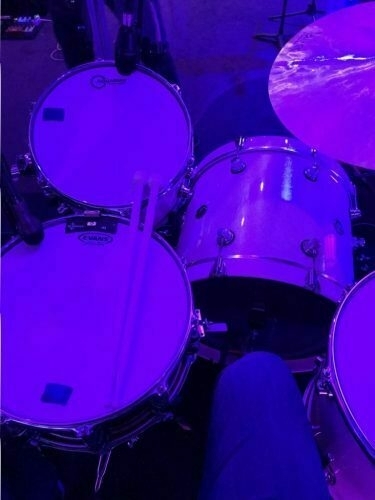
The worship team was short a drummer for the week; with the middle daughter now taking drum lessons I have an electronic kit at home that I can practice on.
It was really a lot of fun. My goal was to practice enough that I didn’t embarrass myself, and I think I managed that. To be fair, the songs were relatively easy. Still, I hope they let me do it again sometime.
For All The Saints
This great hymn was sung at the end of President George H. W. Bush’s funeral this morning. Written by Anglican priest William Walsham How in 1864, I’m always drawn to how it gets the sentiments of a Christian funeral so right.
(The typical hymn tune setting SINE NOMINE by Ralph Vaughan Williams doesn’t hurt anything, either, though I do remember struggling mightily to play it unrehearsed as a teenaged church pianist.)
For all the saints who from their labors rest,
who Thee by faith before the world confessed;
Thy name, O Jesus, be forever blest.
Alleluia, Alleluia!
Thou wast their Rock, their Fortress, and their Might;
Thou, Lord, their Captain in the well-fought fight;
Thou, in the darkness drear, their one true Light.
Alleluia, Alleluia!
O blest communion, fellowship divine!
We feebly struggle, they in glory shine;
yet all are one in Thee, for all are Thine.
Alleluia, Alleluia!
And when the strife is fierce, the warfare long,
steals on the ear the distant triumph song,
and hearts are brave again, and arms are strong.
Alleluia, Alleluia!
But when there breaks a yet more glorious day;
the saints triumphant rise in bright array;
the King of glory passes on His way. Alleluia, Alleluia!
From earth’s wide bounds, from ocean’s farthest coast,
through gates of pearl streams in the countless host,
in praise of Father, Son, and Holy Ghost.
Alleluia, Alleluia!
Of disappointment and unexpected footwear
A week ago I ordered some foam replacement earbud covers from Amazon. Friday the package showed up. It did not contain foam replacement earbud covers. Instead, it contained this pair of handsome Spider-Man socks, even in my size!

After a brief consultation with Amazon customer service, my order was refunded and they’re letting me keep the socks. Now I’m still waiting a few more days for another order of earbud covers, but on the whole, we’ll call it a win.
The Emperor and the Empty Tomb
A fascinating and engaging essay from the LA Review of Books (HT: Matthew Loftus):
When Wilhelm Froehner died in 1925, at the house on the Rue Casimir-Périer where he had lived since the reign of Napoleon III, he left behind among his possessions a curious inscription that might be the oldest surviving artifact of Christianity. … Froehner, sadly, took to his grave all but the most exiguous details about how he came into possession of the stone, putting us at one further remove from being able to grasp its meaning. The Greek text of the Nazareth inscription is easy enough to interpret. But the origin of the stone, and its historical significance, are puzzles that remain both unresolved and tantalizing.
Chaplain Mike: Exiting the Evangelical Wilderness
Oh man, I really appreciated this summary from Chaplain Mike over at InternetMonk.com today. While my path isn’t exactly the same as his has been, I resonate strongly with several of the moves he describes. He summarizes his move from the left-hand column to the right-hand column in a little table:

It’s worth reading Mike’s little summaries of each of those movements, but I found his concluding thoughts particularly interesting:
Here is what hit me earlier this week. The differences can be summed up in two letters. “J” and “P”. You may recognize them as the final letters in the Myers Briggs personality type indicator. While Myers Briggs has been somewhat discounted, it got me wondering. Have my theological choices been largely been a product of my personality or personal preferences? Is it just coincidence that many denominations are largely in one column or the other?
Then Wednesday’s Post came along with this humdinger.
Haidt (along with Richard Beck) have convinced me that when we take a stand for “truth” or “morality,” we are primarily revealing deep, fundamental visceral and emotional feelings and then using rational arguments to justify our “righteous” position. Furthermore, those who are on the more “liberal” end of the spectrum react intuitively to different things than those on the “conservative” end. (Chaplain Mike)
…
[I]t makes me wonder if most of my reasons for the theological changes I have made are because of the way I am wired. If I had been wired differently maybe I would have been quite happy to stay in the church of my youth. Conversely, perhaps those who are raised in traditions like the one I am currently in, and who crave certainty in their innermost being end up in those churches that promise more of that. And perhaps there are those who find they do not fit, and chose to chuck the whole church thing altogether.
Lots for me to consider there.
A night with Bruce Hornsby’s brain
Last Friday night my wife and I had the opportunity to go hear Bruce Hornsby play a solo show at the Paramount Theater in Cedar Rapids. Hornsby is an interesting character - a fantastically talented pianist who has made his fame and fortune in rock and jam band genres, but who has made multiple bluegrass records with Ricky Skaggs and drops classical music into the middle of pop tunes.
When I first heard Hornsby’s stuff probably 10 years ago, I quickly recognized that my own piano styles and harmonizations aren’t too far away from what he plays… to the point that it was almost uncanny. So the chance to see him play in person was not one I was going to pass up.
Hornsby’s current tour is just him with a microphone and a piano (a Steinway concert grand), but with those two tools he commanded the stage for just over two hours. He set the tone by starting the concert with his biggest hit, “The Way it Is”, into which he dropped a long improvisatory section, morphed it into a couple minutes of a Bach something-or-other, and then morphed it back into the close of the song. Later on in a jam section he dropped in an avant garde ‘perpetual motion’ piece by American composer Elliott Carter. Even if he did spend the majority of his years with The Grateful Dead, the dude has serious piano chops.
When we got to our seats on the right-hand side of the theater, my wife lamented that we should’ve gotten seats on the other side so she could see his hands as he played. And I get the fascination with seeing those fingers fly over the keys. But for me the fascination was entirely a mental one.
To sit in the auditorium and engage with Hornsby’s brain as he improvised long sections was an amazing experience. I’m not a jazz player, but I hear and read jazz players talk about listening to and interacting with other jazz players, and after this Hornsby concert I finally think I understand what they’re talking about.
When you really understand the playing technique, the harmonies, the nuts and bolts of the music, then you can start to engage at a deeper level - the progressions, the expression, the choice to go around again or branch off somewhere new… it’s really quite a head trip.
I’d love to see Hornsby play again - preferably with a band next time, to experience all of those interactions. Playing good music in a talented group is a intellectually pleasurable exercise for me almost as much as a musical exercise. Sitting in the audience last weekend wasn’t as good as being in the band, but it got pretty close.
A good word from Jonathan Martin
From a recent sermon on his Son of a Preacher Man podcast:
The fake good news only sounds like good news to me and my tribe. The fake good news only sounds like good news if you go to my church. If they’re in another village, it’s bad news for them. But the real good news is not just good news for us, it’s good news for them.
It’s a sermon worth 40 minutes of your time.