
Category: Longform
You are viewing all posts from this category, beginning with the most recent.
The State of my Task Management, 2024
As a new year begins and I settle into a new-ish position at work, it has been time to again rethink my task management strategy.
Let’s set out the constraints first. My work computing ecosystem is a highly-constrained Windows laptop. My employer doesn’t provide any sort of task management software, and restricts any data flow between company devices and personal devices. I have access to my work email and calendar on my personal device, but it’s very hard to move data back and forth between domains.
Historically I haven’t really used task management apps. I have downloaded free ones and purchased paid ones on occasion, tried them out for a week or two, and then fell away from them one I got comfortable enough with the new task or role that the overhead of using the tool outweighed the benefit it provided me. I use my email inbox as my primary to-do list. If an email is still in the inbox, it means I need to take action on it. I like to use the inbox “snooze” function when I can to dismiss the email from my inbox and bring it back at some scheduled later date, but unfortunately “snooze” only works on the web version of Outlook, not the app versions, so I rarely use it. The upside of this is that I always have all my pending tasks staring me in the face. The downside of this is that I always have all my pending tasks staring me in the face.
I paid for Things on my iPhone and iPad a few years ago and have largely neglected them. But right now I have just enough different and new things on my plate between work and church that I need a coordinated reminder system to help make sure I don’t forget something. So last week I jumped back into Things, added a few categories and a couple dozen tasks, put a widget on my iPad Home Screen, and decided to give it a go.
I’m sure I cribbed my basic pattern for using Things from Rands but I have no idea which post. It works like this:
- During the day, as new to-dos come up, dump them into the Things inbox with as little overhead as possible.
- Every morning, triage that Inbox, assign due dates to things that need them, and file them appropriately into projects.
- Every morning, after triage, see what’s in Today. If there’s enough to keep me busy all day, I’m done. If I have some extra bandwidth, review the “Someday” tasks to see if there’s so thing to pull into Today.
- Start working and checking off tasks once they’re completed!
I’ve been working this way for a couple weeks now and I think it might take this time. I really enjoy being able to just quickly dump a to-do onto my phone when I think of it, knowing that I’ve already got a plan for reviewing it later. I have also unexpectedly enjoyed not having all my to-dos staring me in the face. By doing the triage and scheduling tasks, I have a level of comfort in knowing that whatever is on my Today widget on my iPad is all I need to worry about today. I’ve had a couple small panics so far where I jump into the Upcoming view to make sure I do have some particular task scheduled, but I suppose that’ll fade as I start getting more consistent with using Things every day.
Recommended Reading: The Kingdom, The Power, and The Glory by Tim Alberta

My first completed book of the year is one I can wholeheartedly recommend: The Kingdom, The Power, and The Glory by Tim Alberta. Subtitled “American Evangelicals in an Age of Extremism”, journalist Alberta’s book details his many interviews with American Evangelical leaders since the rise of Trump in 2016. He interrogates their motivations, how their words align with their actions, and how those words and actions comport with the teachings of Jesus.
Alberta is uniquely positioned to write a book like this. A professional journalist currently with The Atlantic, he has also written for, among others, Politico and The Wall Street Journal. But, as he reveals in the book’s initial chapters, he is also a pastor’s kid. His father, up until his untimely death, was the pastor of a large Evangelical Presbyterian church in Michigan. Alberta grew up a devoted Christian within that church, and continues today as a professing Christian. The Kingdom, The Power, and The Glory at places verges on memoir. But Alberta’s fluency with evangelical language, teaching, and culture give him an insight and authority that other journalists would lack.
If you have been following along in the Evangelical culture wars post-2016, most of the folks Alberta discusses will be familiar. He introduces them chapter by chapter: The Falwells and Liberty University, Robert Jeffress, and the Southern Baptist Convention. Firebrands like Greg Locke. Unabashed politicos like Ralph Reed. Fradulent historian David Barton. SBC stalwart-turned-outcast Russell Moore. Journalist Julie Roys. Pastor Brian Zahnd as a Midwestern prosperity preacher turned lonely prophet.
Whether it’s on purpose or just so close to home (for both the author and me) that Alberta couldn’t avoid it, the theme of children of Evangelicals turning and becoming their parents’ reproof played over and over through the book. Nick Olson, the son of an early Liberty student who came back to teach, only to be driven away when his politics didn’t align. Rachael Denhollender, the conservative homeschooled gymnast who, after bravely testifying against her abuser, became an advocate for sexual abuse victims within her own denomination. Cameron Strang, CEO of Relevant magazine, the son of a religious huckster. Jonathan Falwell, at a crossroads after taking over leadership of the “family business”, Liberty University. Alberta finally questions his own actions and motivations. Would he have been willing to ask these questions, to write this book, were his father still alive and in the pastorate? That question remains forever unknown. I understand, at least a little bit, Alberta’s quandary.
Over the past decade a pattern has emerged for me. When I encounter someone from my generation, usually online, who speaks with a resonant voice of sanity about America’s religion and politics, it turns out they, like me, grew up evangelical, usually homeschooled, and have spent their adult lives forging a path out. I’m thinking of people like author Lyz Lenz, new NYT film critic Alissa Wilkinson, writer and editor (and Alissa’s former podcast-hosting sidekick) Sam Thielman, NPR journalist Sarah McCammon, and famous lawyer spouse Jacob Denhollander, kindred spirits all. I’m now going to add Tim Alberta to that list.
At the end of the book, Alberta expresses an uncertain hope that this younger generation is successfully turning the evangelical world away from the worst of its political debauchery. To my mind, that jury is still out. Leader after leader throughout the book express their befuddlement and confusion as to why so much of the Evangelical church has been willing to follow political prophets away from the call of Jesus. Like them, Alberta doesn’t have the answer. But with this book, he has done what he can: incontrovertably documenting the political corruption of the American Evangelical church for anyone willing to read it.
A short note on Travel Planning
I have found myself, since returning home from Washington, DC in mid-December, without any travel on my calendar. Normally I travel a half-dozen times per year for work, meaning usually at any given point I’ve got something at least on the calendar. But right now? Nope.
That may be changing here in the next week or two, with a new possible travel destination for me: York, UK. Somehow I’ve been to Europe 8 or 9 times but never to the UK. I’d be happy to add it to my list!
My 2023 Reading in Review
Another year full of books! (Previous summaries: 2022, 2021, 2020, 2019, 2018, 2017, 2016, 2015, 2014, 2013, 2012, 2011, 2010, 2009, 2008, 2007…
I read 72 books for the year, which feels like a nice even number. There’s still a lot of theology and science fiction in the list, but I read more science this year, along with several memoirs.
Here’s the full list of reading, with particular standouts noted in bold:
Theology
- Out of the Embers: Faith After the Great Deconstruction by Bradley Jersak
- On the Soul and the Resurrection by St. Gregory of Nyssa
- Reparations: A Christian Call for Repentance and Repair by Duke L. Kwon
- Sanctifying Interpretation: Vocation, Holiness, and Scripture by Chris E. W. Green
- The Peaceable Kingdom: A Primer in Christian Ethics by Stanley Hauerwas
- Art and Faith: A Theology of Making by Makoto Fujimura
- Not All Who Wander (Spiritually) Are Lost by Traci Rhodes
- A Hidden Wholeness: The Journey Toward an Undivided Life by Parker J. Palmer
- Trauma-Informed Evangelism: Cultivating Communities of Wounded Healers by Charles Kiser
- Christ in Evolution by Ilia Delio
- Breathing Under Water: Spirituality and the Twelve Steps by Richard Rohr
- The Phenomenon of Man by Pierre Teilhard de Chardin
- The New Being by Paul Tillich
Green is wonderful here. I posted a few excerpts while reading it that would be a good introduction.
Science and History
- The Evolution of Knowledge: Rethinking Science for the Anthropocene by Jurgen Renn
- Unmasking Autism: Discovering the New Faces of Neurodiversity by Devon Price
- Fundamentals of Software Architecture: An Engineering Approach by Mark Richards
- Mindsight: The New Science of Personal Transformation by Daniel J. Siegel
- The Technology Trap: Capital, Labor, and Power in the Age of Automation by Carl Benedikt Frey
- Out of the Wreckage: A New Politics in the Age of Crisis by George Monbiot
- The Book of Genesis: A Biography by Ronald Hendel
- Digging Up Armageddon: The Search for the Lost City of Solomon by Eric H. Cline
- Secular Faith: How Culture Has Trumped Religion in American Politics by Mark Alan Smith
- Until the End of Time: Mind, Matter, and Our Search for Meaning in an Evolving Universe by Brian Greene
- The Book of Job: A Biography by Mark Larrimore
- On the Origina of Time: Stephen Hawking’s Final Theory by Thomas Hertog
- Quantum Reality by Nick Herbert
- The Talmud: A Biography by Barry Scott Wimpfheimer
- The Case Against Reality: Why Evolution Hid the Truth from Our Eyes by Donald D. Hoffman
Memoir and Biography
- Every Good Boy Does Fine: A Love Story, in Music Lessons by Jeremy Denk
- Still Just a Geek: An Annotated Memoir by Wil Wheaton
- Agent Josephine: American Beauty, French Hero, British Spy by Damien Lewis
- Heretic: A Memoir by Jeanna Kadlec
- Joel on Software by Joel Spolsky
- God on the Rocks: Distilling Religion, Savoring Faith by Phil Madeira
- All My Knotted-Up Life: A Memoir by Beth Moore
- Mystics and Zen Masters by Thomas Merton
- Birth of a Dancing Star: My Journey from Cradle Catholic to Cyborg Christian by Ilia Delio
- How Far the Light Reaches: A Life in Ten Sea Creatures by Sabrina Imbler
- Being Heumann: An Unrepentant Memoir of a Disability Rights Activist by Judith Heumann
- Making It So: A Memoir by Patrick Stewart
I posted some appreciation for Stewart before I got my hands on his memoir. The memoir did not disappoint. He’s an imperfect, lovely man. The book was a pleasure to read. Also, he’s a great example of why we need funding for arts and arts education. But I digress.
Other Miscellaneous Non-Fiction
- My Bright Abyss by Christian Wiman
- Oscar Wars: A History of Hollywood in Gold, Sweat, and Tears by Michael Schulman
- The Ultimate Quest: A Geek’s Gude to (The Episcopal) Church by Jordan Haynie Ware
- Transitions: Making Sense of Life’s Changes by William Bridges
Fiction
- The Three-Body Problem by Liu Cixin (re-read)
- A Closed and Common Orbit by Becky Chambers (re-read)
- Dead Lions by Mick Herron
- Don’t Cry for Me by Daniel Black
- The Passenger by Cormac McCarthy
- The Bayern Agenda by Dan Moren
- Record of a Spaceborn Few by Becky Chambers
- Tomorrow, and Tomorrow, and Tomorrow by Gabrielle Zevin
- Hunting Time by Jeffrey Deaver
- Ordinary Monsters by J. M. Miro
- The Mountain in the Sea by Ray Nayler
- The Morning Star by Karl Ove Knausgard
- Babel by R. F. Kuang
- Translation State by Ann Leckie
- Average Jones by Samuel Hopkins Adams
- The Odyssey by Homer, trans. Emily Wilson
- Red Queen by Juan Gomez-Jurado
- The Left Hand of Darkness by Ursula K. Le Guin
- The Fifth Season by N. K. Jemisin
- Blackouts by Justin Torres
- Starter Villain by John Scalzi
- The Testament of Mary by Colm Toibin
- Girl One by Sara Flannery Murphy
- Titanium Noir by Nick Harkaway
- My Old Home: A Novel of Exile by Orville Schell
- The Helsinki Affair by Anna Pitoniak
- Time’s Mouth by Edan Lepucki
- The Collector by Daniel Silva
Schell’s epic story following a young man’s life growing up in 20th century China is beautiful and tragic and very worth the read.
Summary
One of my goals from previous years was to read fewer books written by white guys. By my count, 24 of this year’s books meet that goal… which isn’t as good as I’d hoped it would be. That science section didn’t help in that regard. I made a stronger shift this year, though, away from theology and to science. That wasn’t super-intentional, but just where my interest was at the time.
On to 2024! I’m nearly halfway through my first book of the year.
Chopin Being Mean
I have hacked through the Chopin Ballades for years now. I started learning the first one in high school, and in adulthood I played through #3 and #4 often enough that I can, well, hack through them. I never spent the time working everything out and polishing; I just kept sight reading until I could blaze through it.
This past week I decided it was time to actually sit down with #4 and work it out more carefully. Today I got to this pictured section which, when sight reading, had always thrown me for a loop. Practicing the right hand by itself, I finally realized what makes it such a pain.
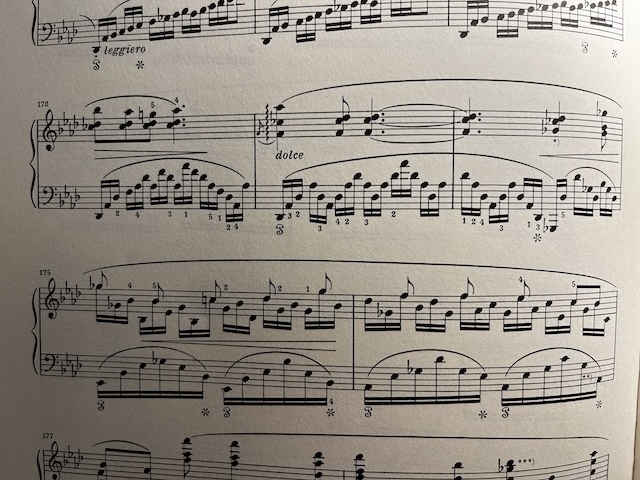
It’s 6/8 time. On the first line, the bass has gone to triplets in each eighth note. Then on the second line, the right hand picks up triplets per eighth, while the left switches to sixteenths. Ok, that’s 3 against 2, no big deal.
But while the right hand is in triplets, the pattern written (as indicated by the eighth notes on the up stems) is a four-note pattern, almost an Alberti pattern. So, you have what is by pattern a four-beat pattern, played as triplets against two in the bass. My brain wants to interpret that as four against two, which is very simple. But it’s not - rhythmically, it’s 3 against 2, but the 3s are logically and musically grouped in sets of four. This one is gonna take my brain a while to work out.
Reviewing Two Decades of My Thoughts
A big chunk of effort in migrating the blog was going through each post to review and clean up content. On the technical side, I started by using a conversion tool that took the Wordpress data dump and transformed it into Markdown files. It was good as far as it went. But it was only so good. I ended up touching every post back to 2004, tagging, cleaning up formatting, improving links when possible, removing them when they were super-dead, etc. It took a while. But it gave me the opportunity to review my own progression of thought and growth in a way I wouldn’t have otherwise been able to, and that made it well worth it. Today I want to review some impressions this review left on me.
Post Content and Strategy
Man, back in the early years I posted a lot. Almost every day for a while, or at least multiple times a week. I started this blog a solid two years before Twitter went live or Facebook became available for non-students, and I used it for a lot of mundane life updates that would eventually move over to FB and Twitter. Once I started engaging on those platforms (and particularly Twitter), my blog posting tailed off to something closer to its current state - roughly one post per week at most.
One thing hasn’t changed so much: I post a lot about books I’m reading. I have written year-in-review blog posts since 2007. My books tag has 165 posts. At times I tried to post about every single book I read; now I’m doing that in short form over on my books site and only summarizing and sharing highlights here. Still reading lots of Christian thought and theology, too. The more things change, the more they stay the same.
Evolution of thought
I grew up in a very conservative, nay, fundamentalist Christian household. Those lessons stuck with me long into adulthood. To steal a hopefully-not-too-outdated term from the youths, wow, a lot of my old content is cringe. To be gentle with myself: I was doing my best to fit in and emulate the examples of good Christian people that I saw and read. And boy, I was good at it. The evangelical-ese just dripped from my tongue. I was super-earnest (good, I guess) and super-presumptuous that I had it figured out (not so good).
I was not always an LGBTQIA-affirming person. I didn’t write anything super-offensive even in my non-affirming days, but I was very clearly non-affirming. You can see cracks starting to form in that wall back as early as 2007 when I pondered whether the church should be fighting same-sex marriage. In 2008 I was reading a bunch of Andrew Sullivan, and was more convinced that same-sex civil marriage should be OK. By 2014 I was fully uncertain what I thought about trans issues, but was sure that we shouldn’t be breaking bruised reeds. I was at heart fully affirming sometime before the COVID era, but I’m sad it took until 2022 for me to publicly post about it.
My journey through and eventually out of evangelicalism was clearly also a search for heroes I could latch onto. Sadly, my posting chronicles how one by one they have fallen. John Piper (eek). Mark Driscoll. Matt Chandler. More recently, and less notably, but still: John G. Stackhouse. I listened to them, quoted them, looked up to them… and then watched them fall by the wayside. Their less-famous acolytes championed so many others that also went off the rails: Mahaney, MacDonald, Mohler. Maybe this accelerated my departure from evangelicalism as much as anything.
I still have a long way to go to undo the tangled mess of my childhood fundamentalism, but I’m happy to see progress. We’ll see what another 20 years bring.
Random thoughts and Surprises
- If you’d asked me who was most influential in my theological evolution by default I’d say N. T. Wright. But if you look back through 20 years of blog posts, another name rises to the surface: Richard Beck. I guess if you need a complement to an Anglican bishop, a Texan Church of Christ psychology professor is a good fit. My nerd self has a ton of respect for the fact that Beck has been blogging on Blogspot since God only knows when and only recently added a Substack since nobody except me uses RSS any more.
- There is one song whose lyrics I quoted probably more than all other songs combined: Rich Mullins’ “Land of My Sojourn”. Amusingly enough, I don’t have those lyrics memorized. I quoted them first as early as 2005 and as recently as 2017 and I’m sure I’ll pull them out again before long.
- There have been friends along the way who are, amazingly, still there and still influential, many of whom I have met in-person rarely or never. We owe Geof (RIP) for being the community leader and glue who brought us together, and I’m not sure any of us will appropriately uphold his legacy. I risk disappointing many by naming any, but two must be named here. Kari (whom I have never met in person but someday simply must), a children’s- librarian-turned-ordained-Baptist-minister who gave me an example of what a Christian feminist looks like, and who always had a timely encouraging word even when I was much more stubborn and conservative than I am now. And then there’s Dan. Have we really only met up that once? Dan is my Canadian brother-from-another-mother, homeschool kid, pianist, sometime worship leader, programmer, armchair theologian, and, most importantly, the inventor of the bullet points format that I adopted. Before we met in person I thought there’s no way this guy could really be this awesome in person. Then we met and I found out I was wrong. One of these days, my friend, we’ll meet again.
Wrapping up
I’ll write a proper 20-year anniversary post when October 2024 comes. In the mean time, I’m glad I had the chance for this retrospective.
Life, man.
Migrating to Eleventy
If you’re reading this post, you’re seeing the updated ChrisHubbs.com as generated by Eleventy, a static site generator. After being on Wordpress for nearly twenty years, this was a significant change!
Why leave Wordpress?
I mean, twenty years of history can’t be all bad, right? Wordpress was originally released in May 2003, and by October 2004 I had a blog up and running it. (Well, Geof was administering it for the first couple years. RIP.) And Wordpress has had amazing growth over two decades and runs a lot of the internet’s websites.
But Wordpress was starting to get frustrating. They seem to be working harder and harder to monetize it, even for users of the free product. Want any social features, sharing, analytics, etc? Use the Jetpack extension. Which is free for some functionality, paid for other. OK, I guess. But then they start giving you dashboard “site health indicators” which will tell you that you have problems and the only solution is to subscribe to the paid service. No thanks.
Why Eleventy?
There are a bunch of static site generators out there. I considered both Eleventy and Astro and did some demo work with each. In the end, I found a nice site theme/template I liked build in Eleventy, and it managed to build my full site without any hiccups. It’s a big site, so that’s a win. My path to publishing is a little more intensive than it was under Wordpress, but when I only publish weekly at best, I can survive that. It’s not that hard.
So, almost twenty years?
Yeah, it was a lot of posts. I cleaned up some of them that were just dead links, but I kept most of them around. Once all the cleanup was done I have 1263 posts migrated over. This one now makes 1264. It feels both monumental and trivial at the same time.
I’ll do a separate post with some more personal thoughts that were prompted by going through almost 20 years of my written thoughts. But for now, hey, at least it’s functional!
Closing down iowadon.org
A year ago I set up my own Mastodon server at iowadon.org. Elon Musk had just bought Twitter and was quite obviously going to ruin it, Bluesky was still a very small beta test, and I thought hey, why not, I would enjoy the project and could try my hand at administrating a social media instance. So I dropped $15 for the domain name and $50 for a year of a cheap VPS and gave it a shot.
It was indeed a fun challenge getting it set up. Once I had it up and functional it was low-maintenance enough - an occasional small version upgrade, a couple moderation requests to resolve. I never promoted the instance much, and as a result I never had more than about half a dozen active users, most of whom I knew personally. And it was fine. But as my domain came up for renewal I asked myself if it was something I wanted to continue, and I decided the answer was no.
It’s not a cost thing. I paid $5/mo to Linode for object storage, and absorbed the server costs by sharing the VPS with some other websites I host. (The things you can get away with when your instance only hosts a few users…) It was a little bit the maintenance time. There was a major upgrade to the Mastodon server queued up and, for the first time in a year, it didn’t run smoothly. And I didn’t feel like spending hours trying to figure it out.
It was also a little bit that Bluesky has opened up, and my social network has hit a pretty good critical mass there. At the moment I’m keeping an eye on both Mastodon and Bluesky, but Bluesky is getting more of my time and interaction. And so I migrated my iowadon.org account over to mastodon.social, emailed all my active users to give them a month’s warning, and at the end of the month I shut it down.
It was a fun experiment, and I’m still bullish on Mastodon as a social network. But after a year of running my own, I’m happy to be just a user again on someone else’s server.
In Praise of Humble, Gentle Men
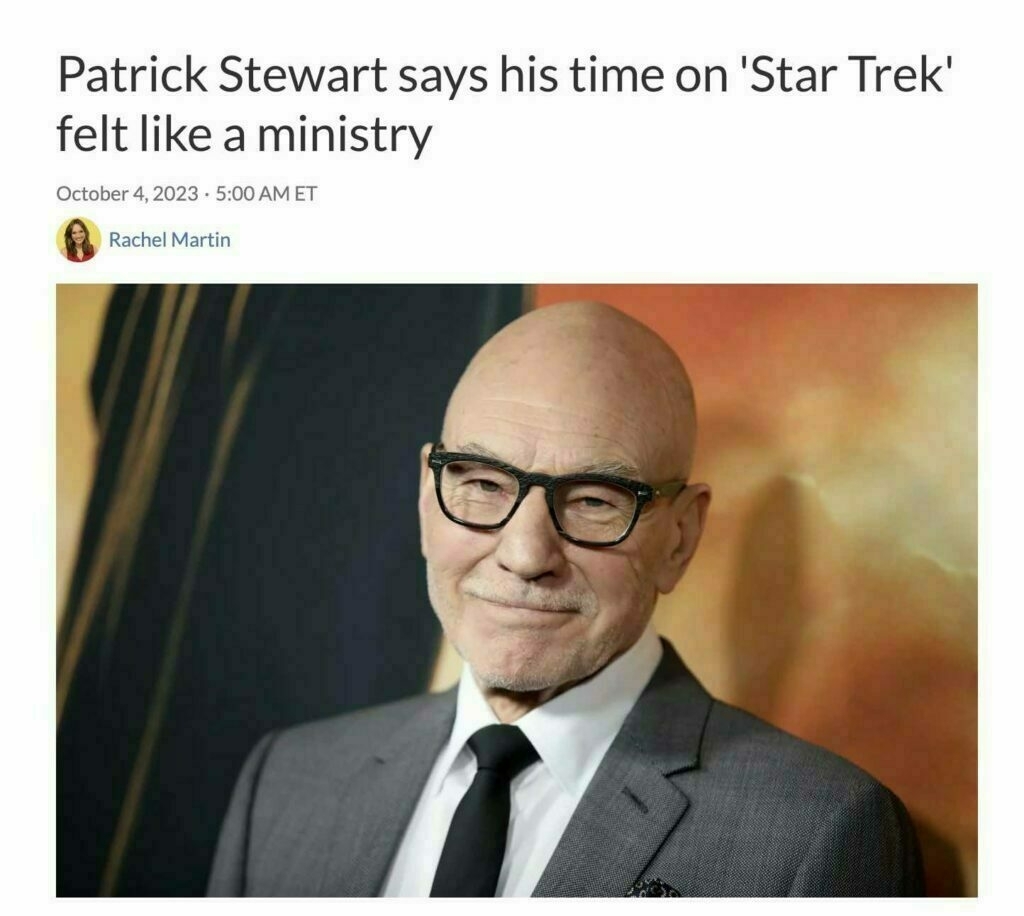
This morning a headline came across my social media feed, with a link to a remarkable interview with actor Sir Patrick Stewart, best known for playing Jean-Luc Picard on Star Trek: The Next Generation for seven seasons. In this interview with NPR reporter Rachel Martin, Stewart describes his time playing Picard with strong religious tones. When Martin noted that many Star Trek fans treat the show with almost a religious reverence, Stewart said this:
Yes. I see it very, very clearly and very strongly. It was about truth and fairness and honesty and respect for others, no matter who they were or what strange alien creature they looked like. That was immaterial. They were alive. And if they needed help, Jean Luc Picard and his crew, his team, were there to give it.
In a sense, we were ministers. And I have heard now so many times from individuals who have been honest enough and brave enough to tell me aspects of their life, of their health, of their mental health. And how it was all saved and improved by watching every week.
I came to ST:TNG right about the time it finished airing, and eventually caught up via VHS recordings. And while I may not be a full-blown Trekkie, TNG is my comfort watch. At its best, the Star Trek series—and especially TNG—portrayed an optimistic future where technology and diplomacy had taken care of systemic social issues; where the leading adults were grown-ups who behaved responsibly, admitted their faults, and worked for the greater good.
None was better in this regard than Stewart’s Captain Picard. He was the best of what you as a man might want to be - an accomplished leader, an artist, a man who put his crew’s needs before his own and held to his principles even when it cost him dearly. In a world of entertainment where so many actors turn out to be real scuzzballs in their personal lives, seeing Stewart reach old age and maintain, by all accounts, his reputation as a man of integrity, it’s hard not to feel his real-life person and his onscreen role merge just a little bit. It warms my heart to see this acclaimed example of a good man.
Whether Stewart attracted good people or just rubbed off on them I don’t know, but the men who acted around Stewart have also continued to display honorable attributes long after the show was done. Wil Wheaton, who played the teenager Wesley Crusher on the show, recounts in his memoir how Stewart and Jonathan Frakes (Commander Will Riker) were men who showed him what a real father should be like after Wheaton’s own parents abused him. And then there’s Levar Burton, who for the seven years of ST:TNG, and for 16 more years around it, hosted Reading Rainbow, encouraging a love of books and reading to children via public television.
None of these men went on to build great empires; none needed to play (or try to be, in real life) overly macho men. And yet here, decades later, they are beloved by so many simply because they have maintained integrity in their lives as men of gentleness and humility.
These led me to think about another humble, gentle man who I’ve written about before who fits the same mold, and who spent decades on television in a similar way. I’m talking, of course, about Fred Rogers. Again we have a man who in most ways wouldn’t live up to the expectations of American masculinity, but who portrayed love, care, generosity, and humility in a way that was as fully genuine in person as it was on the screen.
I can almost hear the response pieces being written at Christian outlets like The Gospel Coalition already. Clearly, they’d say, that as nice as Stewart seems, his “ministry” is some sort of false gospel since, well, he doesn’t believe in God. They’d say all his righteousness is false. They’d say he supports liberal social causes and calls himself a feminist, so clearly he’s problematic.
I have been out of evangelicalism long enough to not care what TGC says any more, but having steeped in it for so long, and having had so many people dear to me who embrace that kind of thinking, I want to offer an alternate take. It goes like this:
We don’t need to put scare quotes around “good” when we talk about men like Stewart, Frakes, or Burton. We recognize admirable characteristics in them because they are there. I might even crib a list that includes things like love, joy, peace, patience, kindness, gentleness, self control…
Now here’s where I’m gonna get all heretical. If these men (or other people like them) are demonstrating the characteristics that Christians know as “fruit of the Spirit”, I’m gonna say that this is evidence of God’s spirit working in them and through them. They may not acknowledge it as such, or even that such a thing exists. But if God is “over all and in all and through all” (Ephesians 4), then does it have to be a big stretch to acknowledge people who model the virtues and priorities that Jesus taught, even if they ascribe them to somewhere else?
The freedom of seeing that God is truly reconciling the whole world has led to a glorious freedom to recognize, admire, and love the good in others without feeling the need to nit pick their theological beliefs. Those who practice the fruit of the Spirit, who do justly and love mercy, who cry out for the poor and oppressed—they will find entering the fulness of the kingdom of God to only be a gentle step from (to borrow Paul’s words) worshiping in ignorance to worshiping in knowledge. Those who carefully articulate a theological line while modeling arrogance, hostility, and gracelessness, though, may find the kingdom to be a bit more of an adjustment.
You get the feeling from reading them that we might be loved
This old concert recording of Rich Mullins at a Wheaton College chapel service in 1997 is an internet classic, but listening through it again today I was struck by his wisdom about the love of God:
I am at an academic place so I need to speak highly of serious stuff. Although I have trouble with serious stuff, I have to admit, because I just think life’s too short to get too heavy about everything. And I think there are easier ways to lose money than by farming, and I think there are easier ways to become boring than by becoming academic. And I think, you know, the thing everybody really wants to know anyway is not what the Theory of Relativity is. But I think what we all really want to know anyway is whether we are loved or not. And that’s why I like the Scriptures, because you get the feeling from reading them that we might be. And if we were able to really know that, we wouldn’t worry about the rest of the stuff. The rest of it would be more fun, I think. Cause right now we take it so seriously, I think, because of our basic insecurity about whether we are loved are not.
I think you should study because your folks have probably sunk a lot of money into this, and it’d be ungrateful not to. But your life doesn’t depend on it. That was what I loved about being a student in my 40s as opposed to in my 20s is I had the great knowledge that you could live for at least half a century and not know a thing and get along pretty well.